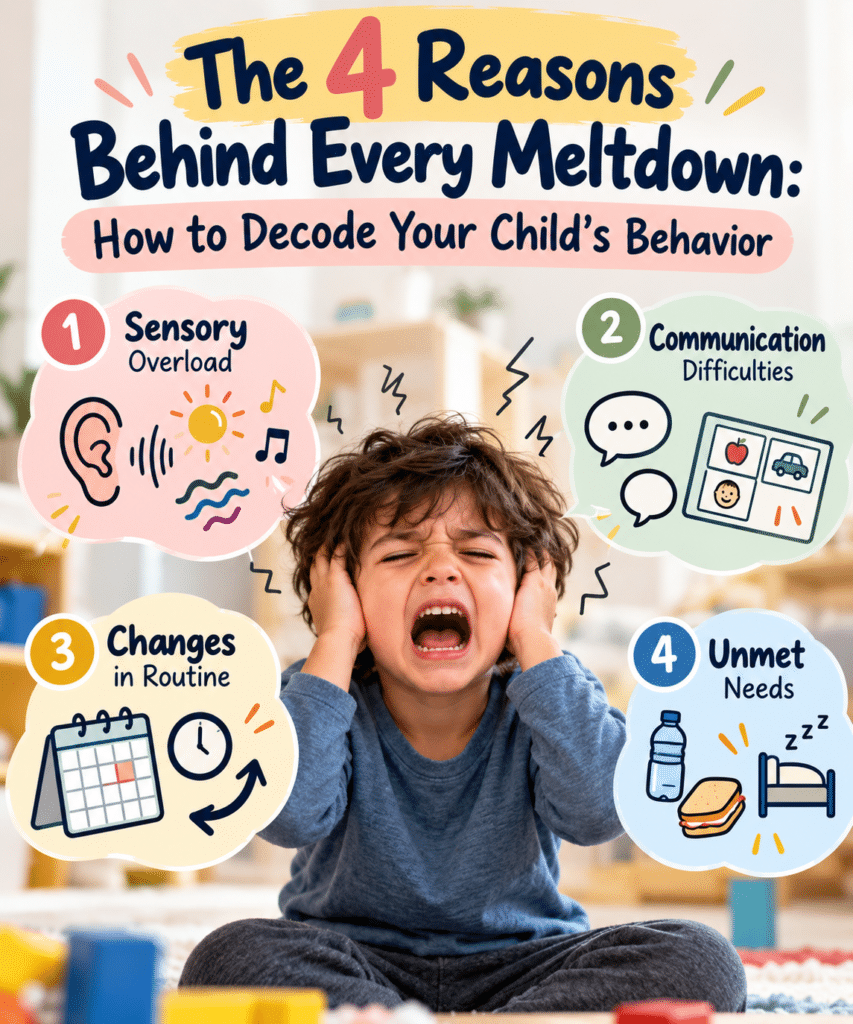
Every meltdown has a reason, and once you learn to spot the reasons behind child meltdowns, most of them get shorter, quieter and less frightening for both of you.
You know the scene. You’re in the grocery store, the cereal aisle is bright and loud, and your child is on the floor screaming because the red cup is not the blue cup. Other shoppers look over. Your own heart is pounding. In that moment it is easy to think your child is being difficult, manipulative or “bad.”
They almost never are. A meltdown is not a performance and not a test of your authority. It is communication from a nervous system that has run out of ways to cope. Children, especially under age six, do not yet have the words or the brain wiring to say, “I’m exhausted, overwhelmed and I need you.” So their behavior says it for them. The reassuring part: in a study of 335 children aged 18 to 60 months, most tantrums were brief, and about three-quarters lasted five minutes or less.
The good news is that nearly every meltdown traces back to one of four causes. Learn them, and you stop reacting to the volume and start responding to the need underneath.
Reason 1: Their body needs something
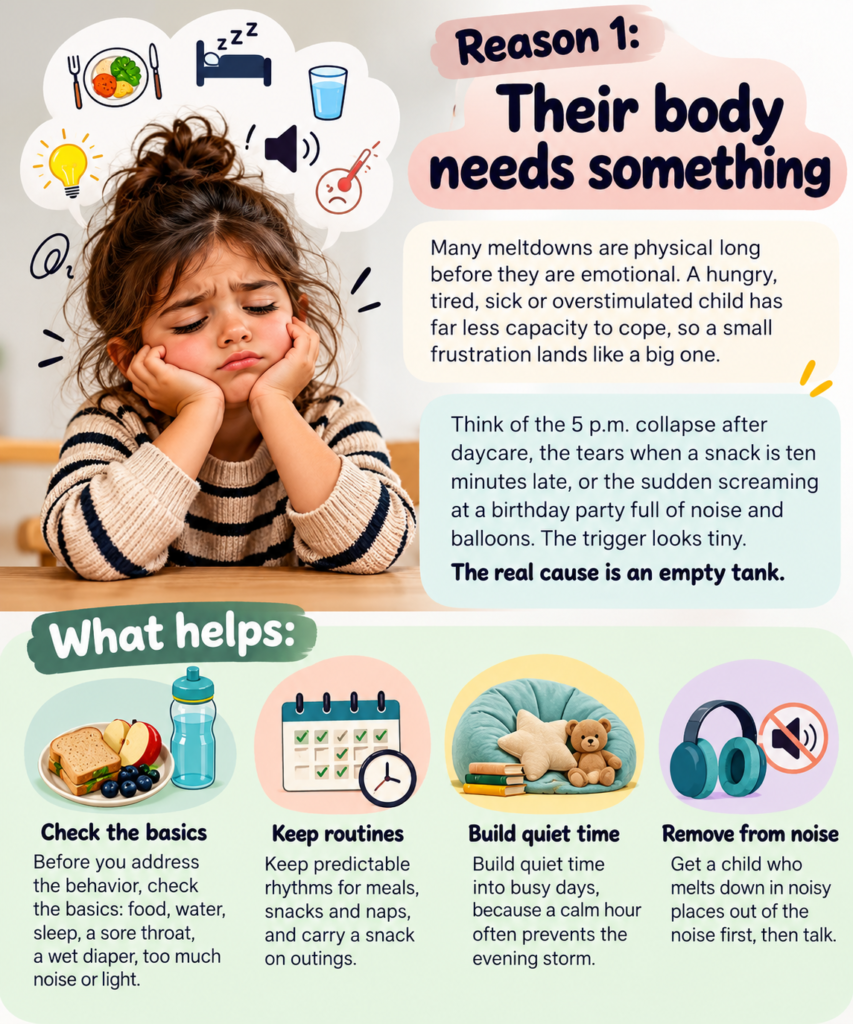
Many meltdowns are physical long before they are emotional. The American Academy of Child and Adolescent Psychiatry lists being tired, hungry, in pain or coming down with a mild illness as common tantrum triggers, so a small frustration can land like a big one.
Think of the 5 p.m. collapse after daycare, the tears when a snack is ten minutes late, or the sudden screaming at a birthday party full of noise and balloons. The trigger looks tiny. The real cause is an empty tank.
What helps:
- Before you address the behavior, check the basics: food, water, sleep, a sore throat, a wet diaper, too much noise or light.
- Keep predictable rhythms for meals, snacks and naps, and carry a snack on outings.
- Build quiet time into busy days, because a calm hour often prevents the evening storm.
- Get a child who melts down in noisy places out of the noise first, then talk.
Reason 2: Big feelings, small toolkit
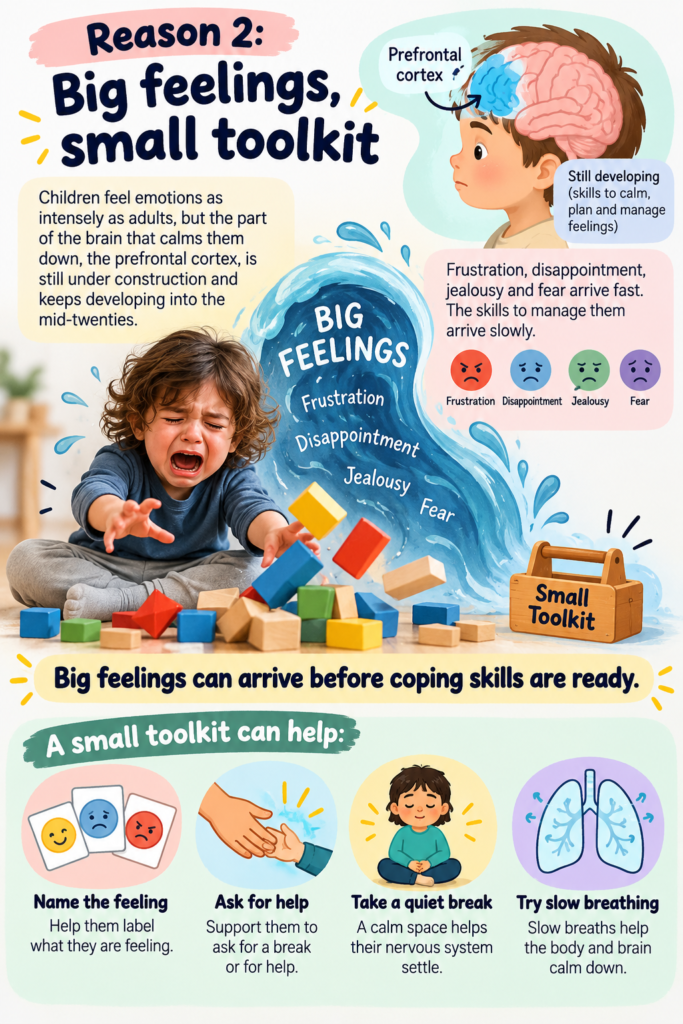
Children feel big emotions, but the part of the brain that helps calm them down, the prefrontal cortex, matures later than other brain areas and keeps developing into the teen years. Frustration, disappointment, jealousy and fear arrive fast. The skills to manage them arrive slowly.
So when the tower falls or a sibling grabs the toy, the feeling floods in and there is nothing in the toolkit to meet it. What you see is crying, hitting or collapsing. What is happening inside is closer to panic.
What helps:
- Stay calm yourself. Your steady voice and body lend your child a nervous system to borrow from.
- Name the feeling in a few words: “You’re so frustrated. That tower was hard to build.”
- Wait to teach until the storm passes. A child in full meltdown cannot take in a lesson.
- Practice calm-down tools when things are quiet, such as slow belly breaths, squeezing a pillow or a cozy corner, so they exist when needed.
Reason 3: They need connection or control
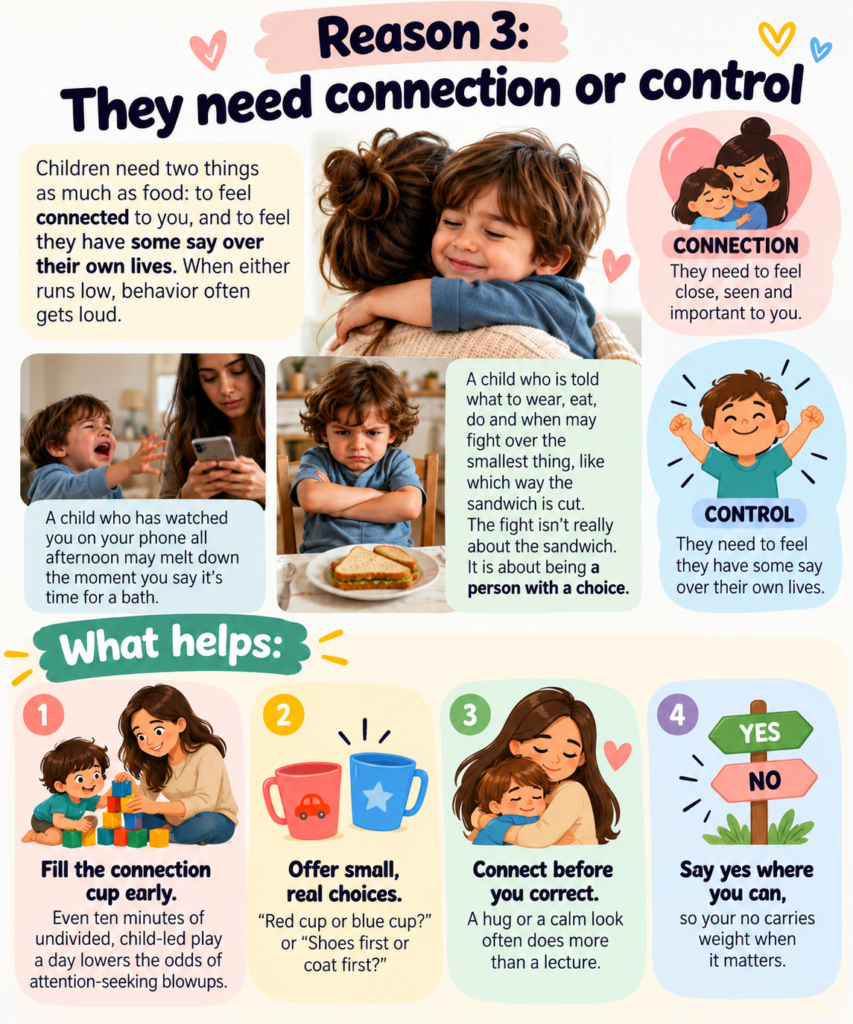
Children need two things as much as food: to feel connected to you, and to feel they have some say over their own lives. When either runs low, behavior often gets loud.
A child who has watched you on your phone all afternoon may melt down the moment you say it’s time for a bath. A child who is told what to wear, eat, do and when may fight over the smallest thing, like which way the sandwich is cut. The fight isn’t really about the sandwich. It is about being a person with a choice.
What helps:
- Fill the connection cup early. Even ten minutes of undivided, child-led play a day lowers the odds of attention-seeking blowups.
- Offer small, real choices: “Red cup or blue cup?” or “Shoes first or coat first?”
- Connect before you correct. A hug or a calm look often does more than a lecture.
- Say yes where you can, so your no carries weight when it matters.
Reason 4: Transitions and demands are too much
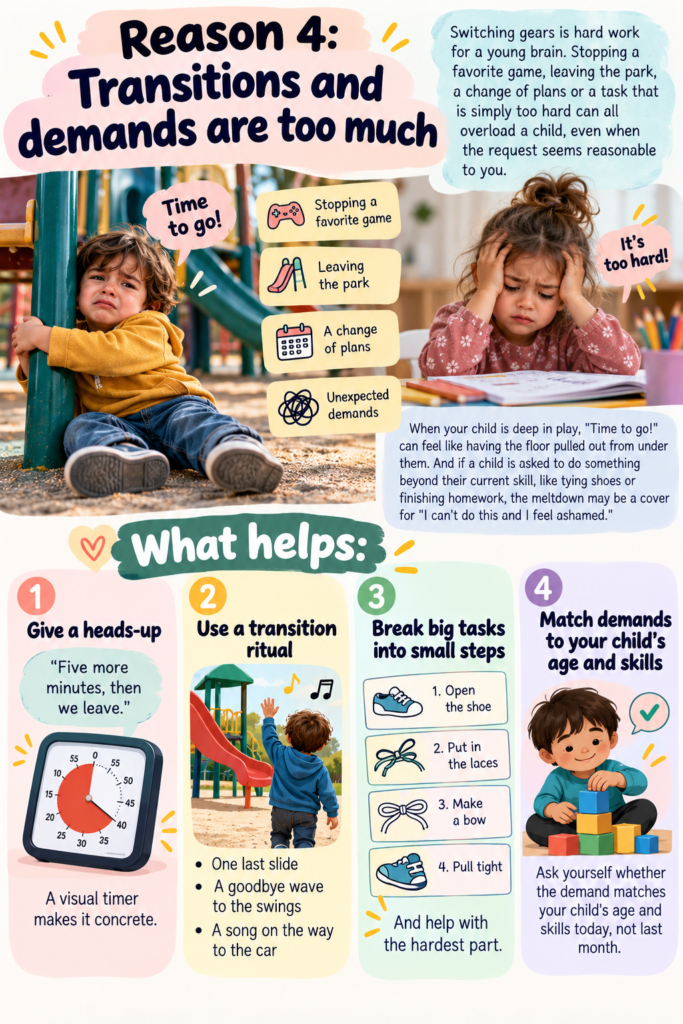
Switching gears is hard work for a young brain. Stopping a favorite game, leaving the park, a change of plans or a task that is simply too hard can all overload a child, even when the request seems reasonable to you.
When your child is deep in play, “Time to go!” can feel like having the floor pulled out from under them. And if a child is asked to do something beyond their current skill, like tying shoes or finishing homework, the meltdown may be a cover for “I can’t do this and I feel ashamed.”
What helps:
- Give a heads-up: “Five more minutes, then we leave.” A visual timer makes it concrete.
- Use a transition ritual, such as one last slide, a goodbye wave to the swings, or a song on the walk to the car.
- Break big tasks into small steps, and help with the hardest part.
- Ask yourself whether the demand matches your child’s age and skills today, not last month.
A quick check you can run in the moment: HALT-S
In the middle of a meltdown you won’t remember four reasons and their fixes. Remember one word instead. Ask yourself, silently, whether your child is:
| Letter | Ask yourself | Points to |
|---|---|---|
| H | Hungry? | Body needs |
| A | Anxious or angry? | Big feelings |
| L | Lonely or needing connection? | Connection and control |
| T | Tired? | Body needs |
| S | Overstimulated by sound, light, crowds or a sudden change? | Body needs, transitions |
Run through the letters and you will often find the cause in under ten seconds.
During the meltdown: keep your words few and your voice low. Make sure your child is safe, stay close, and say something simple like, “I’m here. You’re safe.”
Afterward: once everyone is calm, reconnect with a hug or a quiet moment. Then, in a sentence or two, talk about what happened and what you could try next time. Shame doesn’t teach skills. Calm repetition does.
When to ask for extra support
Meltdowns are a normal part of early childhood. But talk to your pediatrician or a child development specialist if meltdowns are very frequent or last longer than 25 to 30 minutes, if your child hurts themselves or others regularly, if they seem to lose skills they once had, or if the outbursts continue well past the preschool years. Sensory processing differences, ADHD, autism, anxiety and other conditions can make meltdowns more intense, and early support helps.
The takeaway
Your child is not giving you a hard time. They are having a hard time. The next time the floor-screaming begins, take a breath and ask what is underneath: a body need, a big feeling, a need for connection or control, or a transition that was too much.
You won’t get it right every time, and you don’t have to. Each calm response teaches your child that big feelings are survivable and that you are a safe place to land. That lesson lasts far longer than any single meltdown.
Download the free colorful guide (PDF)
References
- Potegal, M., Kosorok, M. R., & Davidson, R. J. (2003). Temper tantrums in young children: 2. Tantrum duration and temporal organization. Journal of Developmental and Behavioral Pediatrics, 24(3), 148-154.
- Merck Manuals Consumer Version. Temper Tantrums. Merck & Co., Inc.
- Yurgelun-Todd, D. (2007). Emotional and cognitive changes during adolescence. Current Opinion in Neurobiology, 17(2), 251-257.
Disclaimer:
The information provided on Autism Routine Hub is for educational and informational purposes only and is not intended as medical, behavioral, psychological, or clinical advice. While the strategies shared here are rooted in evidence-based behavioral practices, every individual’s nervous system and needs are unique. This content should never replace a professional evaluation, diagnosis, or personalized treatment plan from a qualified healthcare provider, pediatrician, or therapist. Always consult with a specialist or clinical professional regarding any specific questions or safety concerns you may have about a medical, behavioral, or neurodivergence-related condition.
جواب دیں