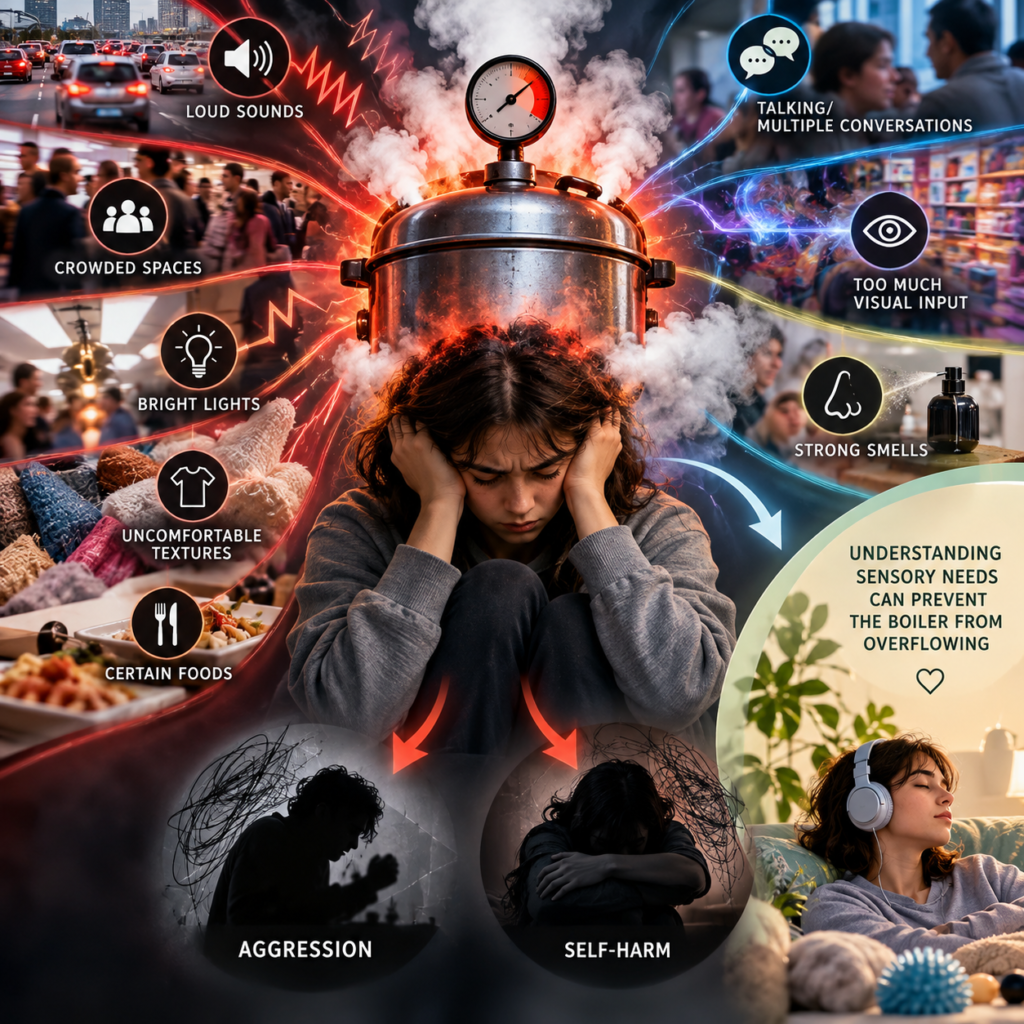
Picture a Tuesday morning commute. A fluorescent tube flickers in the train carriage. Someone’s perfume hangs in the air, a stranger’s headphones leak a tinny beat, and the tag in your shirt has been scratching since you dressed. Nothing here is an emergency. Everyone around you is scrolling their phones, calm.
By the time you reach the office, your body has been bracing for 40 minutes. Then a colleague laughs loudly, a printer starts up, and a manager taps your shoulder. Something that looks, from the outside, like it came from nowhere takes over: a sharp word, a slammed door, a fist against a wall, nails dug into skin.
To everyone else it seemed sudden. To you, the pot had been heating since 7 a.m.
What sensory overload really is
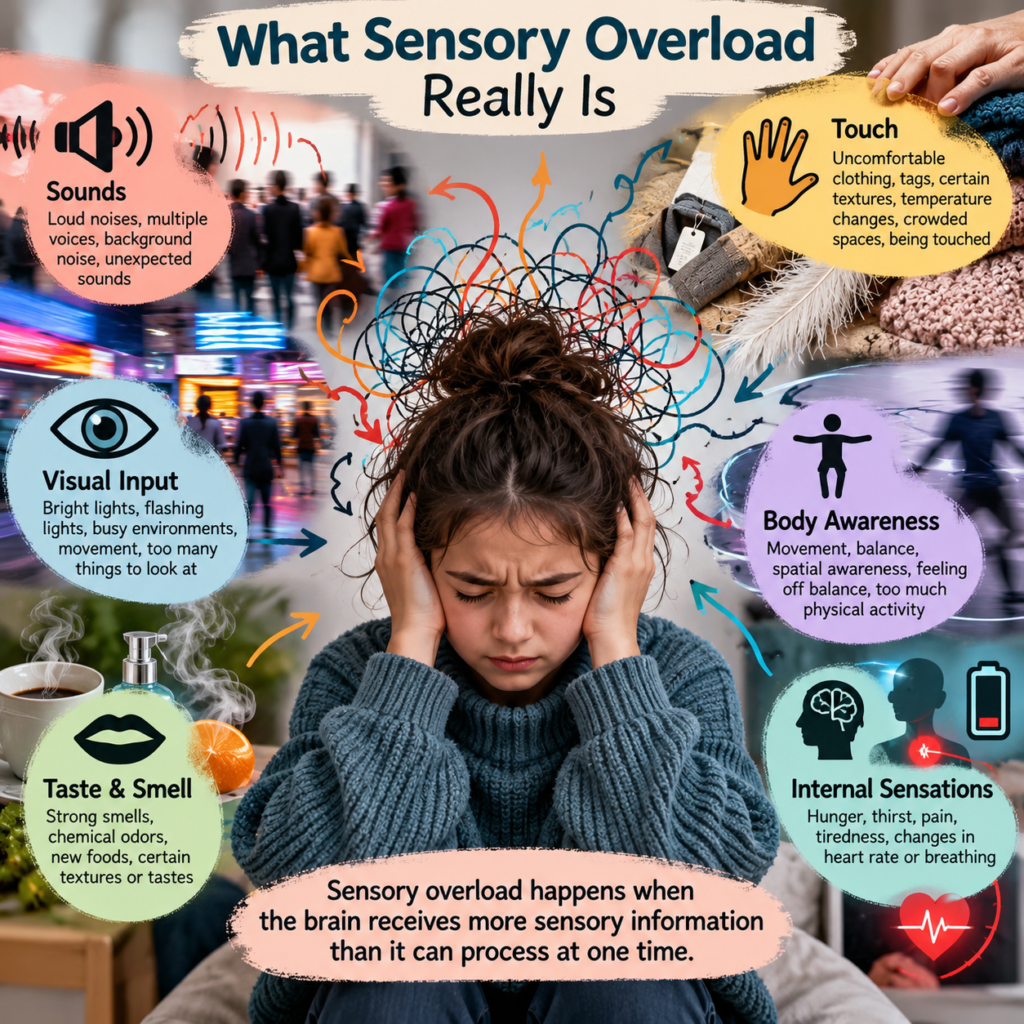
Sensory overload happens when the nervous system receives more input than it can filter, sort and process. For many autistic adults, the brain doesn’t automatically dial down background information. The hum of a fridge, the glare of a screen, a coworker’s cologne and a clock ticking all arrive at similar volume, alongside the conversation that is supposed to matter.
It isn’t limited to sound. Autistic people can be over-responsive (hypersensitive) or under-responsive (hyposensitive) across any sense:
- Sound: sudden noises, overlapping voices, background music
- Light and vision: fluorescents, flicker, busy patterns, screensl
- Touch: clothing seams, light touch, unexpected contact, textures
- Smell and taste: perfumes, cooking, food textures
- Interoception: missing or misreading hunger, pain, temperature or the body’s own stress signals
Sensory differences are part of the diagnostic criteria for autism, yet they are still talked about as a quirk or a childhood issue. They are neither. For many adults they shape every working day.
The boiler no one can see
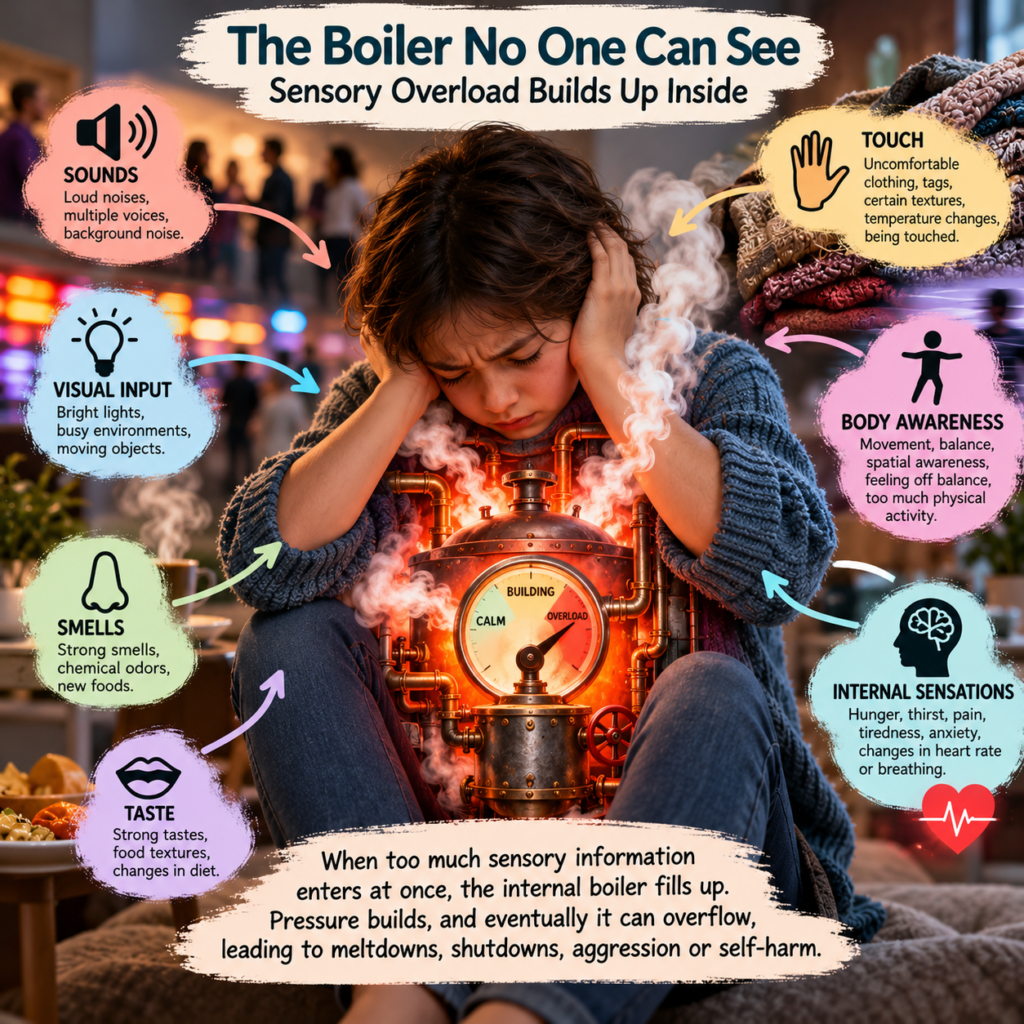
Think of a boiler with a pressure gauge nobody else can read. Each small sensory hit adds pressure: the bright lights, the noise, the unexpected schedule change, the effort of making eye contact and decoding tone. Because the pressure builds inside, outsiders only notice the moment the valve gives way.
Two things keep the boiler hidden in adults.
Masking. Many autistic adults spend years suppressing stims, forcing eye contact, rehearsing small talk and hiding discomfort to pass as neurotypical. Masking is exhausting in its own right, and it means distress is held in rather than released in small, manageable ways. Research on camouflaging has linked it to burnout, anxiety, depression and higher suicidal thoughts.
Late or missed diagnosis. Adults, and especially women and people assigned female at birth, are often diagnosed late or not at all. Without a name for what is happening, they blame themselves: why can’t I cope with things everyone else handles?
The result is accumulation. A person can hold it together through a whole day, then fall apart at home, or fall apart at work over something that looks trivial. The final straw gets blamed. The hundred earlier straws go unseen.
When the valve gives way: meltdowns, aggression and self-harm
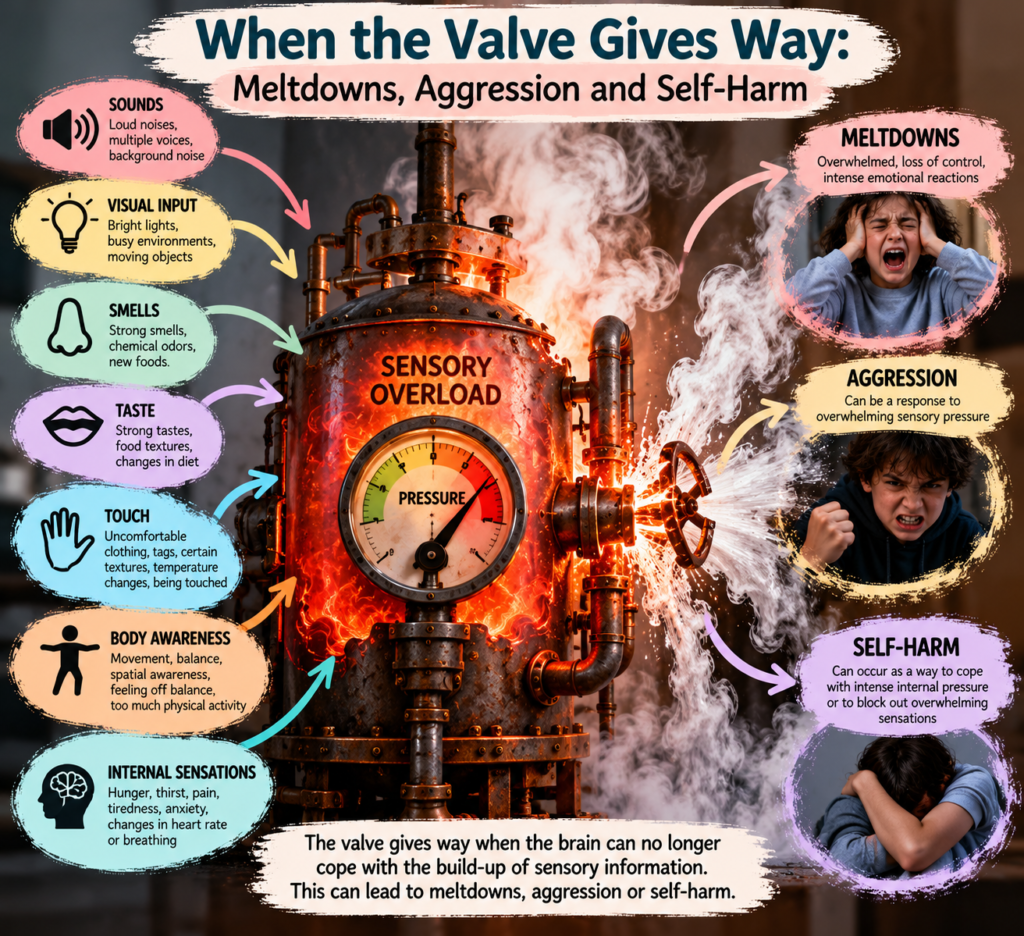
When the nervous system is overwhelmed, the thinking part of the brain goes offline and survival responses take over. In autistic adults this can look like:
- A meltdown: an involuntary loss of control, often with shouting, crying, pacing or lashing out. It is not a tantrum and it is not manipulation. There is no audience being played.
- Aggression: snapping, throwing or breaking objects, pushing past people, or hitting out. It is typically a reaction to feeling trapped or overwhelmed, not a plan to hurt someone. Many autistic adults feel deep shame about it afterward.
- Shutdown: the quieter version, with going silent, freezing, losing speech or withdrawing completely.
- Self-injury: hitting or biting oneself, head-banging, scratching or picking skin. It can also be harder to spot.
Self-injury in particular deserves care. Studies suggest autistic people are more likely than the general population to self-harm, and are at significantly higher risk of suicidal thoughts and behavior. Some people describe self-injury as a reaction to unbearable pressure or a way to interrupt overwhelming input. But it is a sign of distress to be taken seriously, not a coping strategy to accept, and it can cause real harm over time.
What unites all of these is that they are signals. Treating them as bad behavior to be punished makes things worse. It adds shame and fear to a person who is already overwhelmed, and teaches them to mask harder.
A world built for someone else’s senses

Most public and professional spaces are designed around neurotypical tolerance. That mismatch is the pressure source, far more than any flaw in the autistic person.
- Open-plan offices: constant noise, movement, interruptions and no place to retreat.
- Public transport, supermarkets and gyms: unpredictable, loud, bright and crowded, often with no way to leave quickly.
- Social expectations: small talk, eye contact, team-building events and loud restaurants add sensory and social load at the same time.
- Unspoken rules: being told to “just ignore it” or “calm down” signals that the problem is the person’s reaction, not the environment.
- Relationships and family: partners and relatives may read withdrawal as coldness and meltdowns as anger, which breaks trust on both sides.
When the same people are then judged on how they cope, the cycle tightens. Overload leads to an outburst, the outburst brings consequences or shame, and shame leads to more masking and more hidden pressure. Some adults lose jobs, relationships or housing over behavior that was a predictable response to an environment that never accommodated them.
Letting the pressure out safely
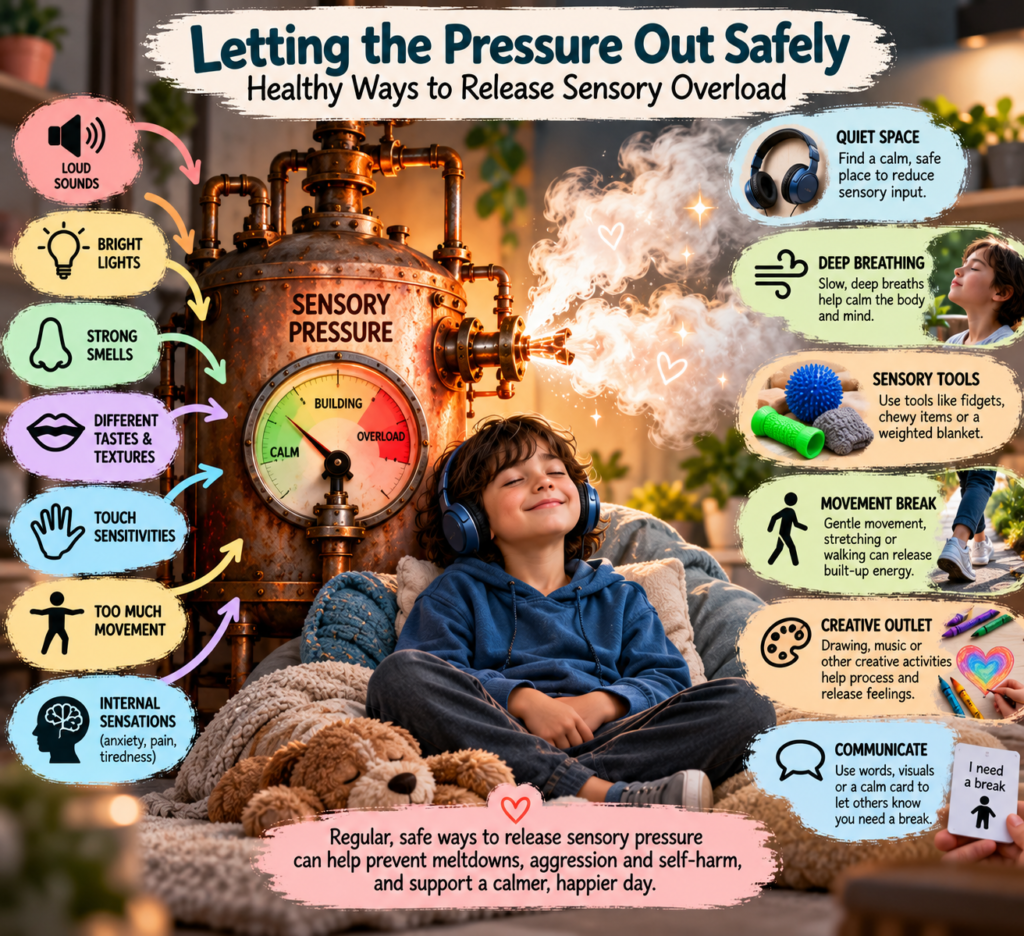
The goal is to lower the pressure before the valve gives way, not to suppress the response afterward.
For autistic adults
- Learn your early signs: irritability, tight jaw, losing words, restlessness, feeling “buzzy.” Catching the first sign is easier than stopping the last one.
- Build in recovery time. Quiet breaks, dim lighting and low-demand time between busy events matter more than they look.
- Use tools that cut input: noise-cancelling headphones, sunglasses, soft or tagless clothing, earplugs, a predictable routine.
- Keep a simple trigger log. Patterns often show up within a few weeks and make requests for adjustments easier to explain.
- Look for an occupational therapist or clinician with autism experience who can assess sensory needs, and consider a diagnostic assessment if you have never had one.
For employers, partners and friends
- Offer quiet spaces, flexible seating, remote or hybrid days, and written rather than only verbal instructions.
- Give warning of changes and avoid surprise contact or crowded events with no exit.
- During a meltdown, lower demands: reduce noise and light, speak less and more slowly, give space, and don’t argue or ask for explanations. Talk it through only after recovery.
- Respond to aggression as a distress signal first. Safety matters, but so does calm, and punishment rarely reduces future incidents.
If self-harm is part of the picture, it needs proper support, ideally from a professional who understands autism. Sensory-friendly environments and earlier recovery time can reduce how often the pressure gets that high.
Seeing the gauge
Autistic adults aren’t “too sensitive” or “too angry.” They are carrying pressure most people never have to feel, in spaces that were not designed with them in mind. When we learn to read the gauge, through quieter spaces, earlier breaks, kinder responses and fewer demands to mask, the valve stops being the only thing people can see.
Disclaimer:
The information provided on Autism Routine Hub is for educational and informational purposes only and is not intended as medical, behavioral, or psychological advice. While the strategies shared here are rooted in evidence-based practices, every individual is unique. This content should not replace professional consultation, diagnosis, or treatment from a qualified pediatrician, therapist, or healthcare provider. Always seek the advice of a specialist regarding any questions you may have about a medical or neurodivergent condition.
References
Crane, L., Goddard, L., & Pring, L. (2009). Sensory processing in adults with autism spectrum disorders. Autism, 13(3), 215-228.
Hull, L., Petrides, K. V., Allison, C., Smith, P., Baron-Cohen, S., Lai, M.-C., & Mandy, W. (2017). “Putting on my best normal”: Social camouflaging in adults with autism spectrum conditions. Journal of Autism and Developmental Disorders, 47(8), 2519-2534. https://doi.org/10.1007/s10803-017-3166-5
Leave a Reply