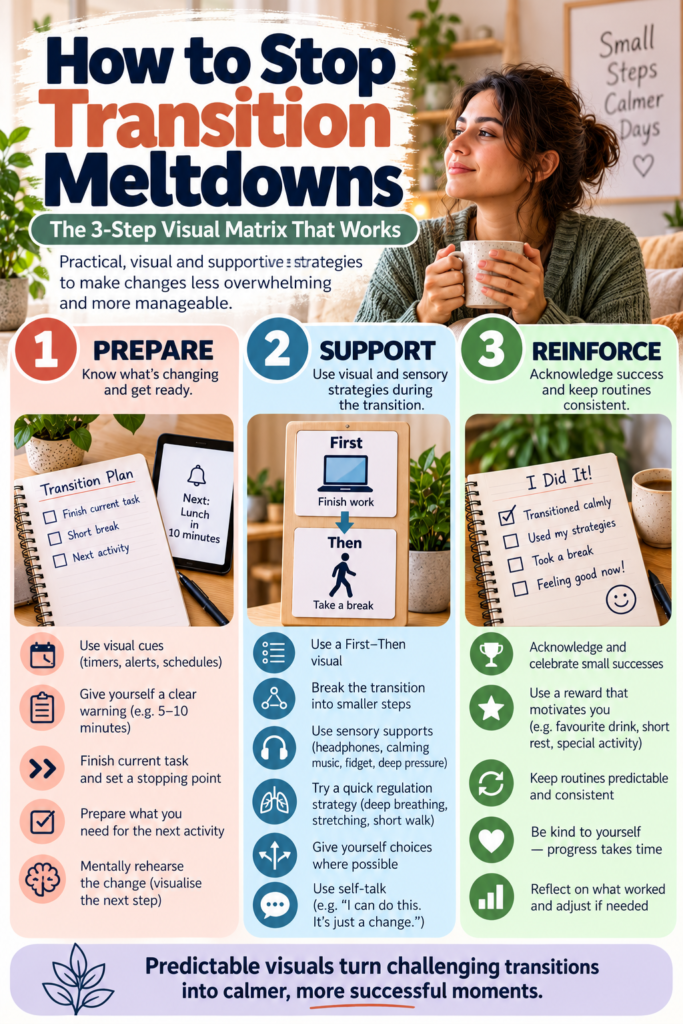
You say “five more minutes, then shoes on.” Five minutes later, your child is on the floor, shoes are flying, and you are both in tears. Transition meltdowns are not bad behavior or bad parenting. They are a predictable reaction to a child’s world changing without warning, and a simple visual matrix can prevent most of them.
Below, you will learn why transitions are so hard, the 3-step matrix that makes them calm, and the mistakes that quietly undo it. At the end, you can grab the free colorful printable version and start tomorrow morning.
Why transitions trigger meltdowns: the predictability gap
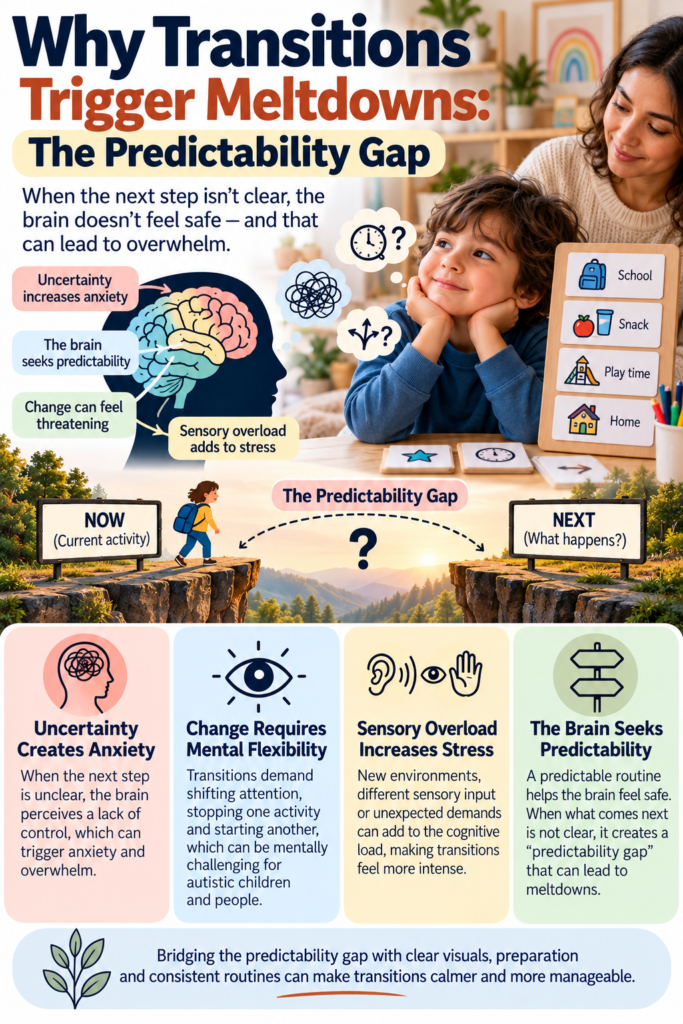
Transitions feel threatening to children because they cannot predict what comes next, and unpredictability is a stress signal for any brain. Young children also have limited working memory and still-developing executive function, so “after snack we’ll do shoes, then the car, then the park” does not stay put in their heads. Spoken words vanish the moment they are said.
Three things happen at once in a transition:
- Loss of control. The child is mid-play, and an adult ends it. Their activity stops, but nobody told them when it would.
- Uncertainty. “Where are we going? How long? Will I get to come back to this?” Unanswered questions feel like danger.
- Mental switching cost. Shifting attention from one task to another takes real effort, and it is harder when the child is tired, hungry, or already overstimulated.
The result is fight, flight, or freeze: yelling, running away, or going limp. Children who are autistic, have ADHD, or are highly sensitive tend to feel this more strongly, but nearly every young child has the same pattern.
The fix is not a better warning. It is making the day visible, so the child can see what is happening, what is next, and when the current thing ends.
The 3-step visual matrix
The matrix is a simple board with a row of picture cards (the day’s routine), a “Now” spot, and a “Finished” box. It works because each step removes one cause of the meltdown.
Step 1: Set a fixed schedule
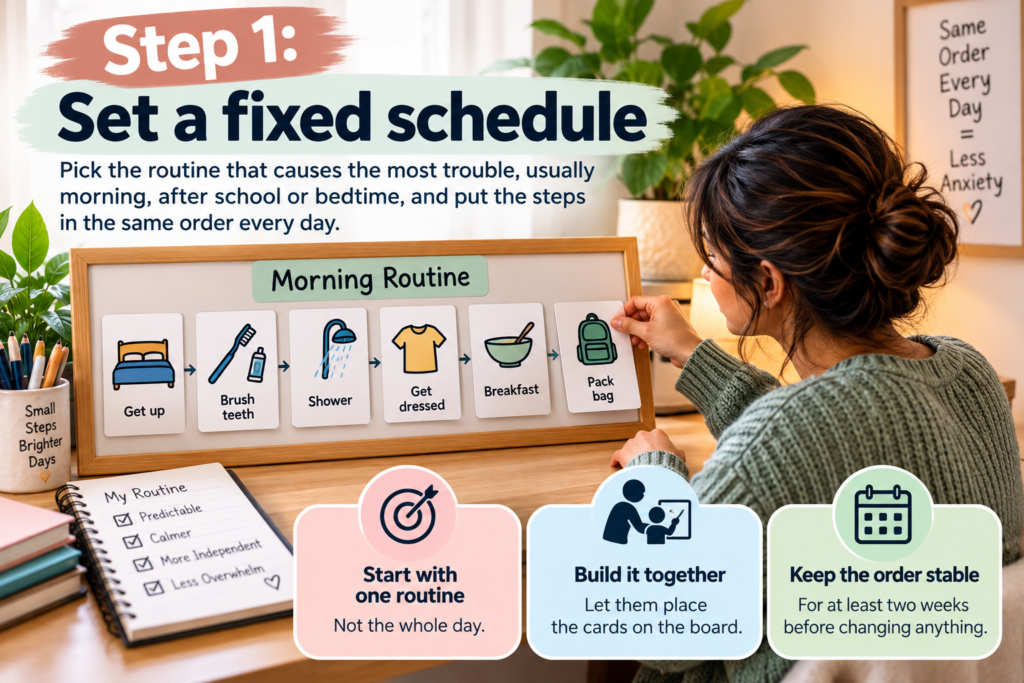
Pick the routine that causes the most trouble, usually morning, after school, or bedtime, and put the steps in the same order every day. Five to six cards is plenty. A predictable order does most of the work, because the child learns what comes next without being told.
- Start with one routine, not the whole day.
- Build it with your child: let them place the cards on the board.
- Keep the order stable for at least two weeks before changing anything.
Step 2: Use clear visual icons
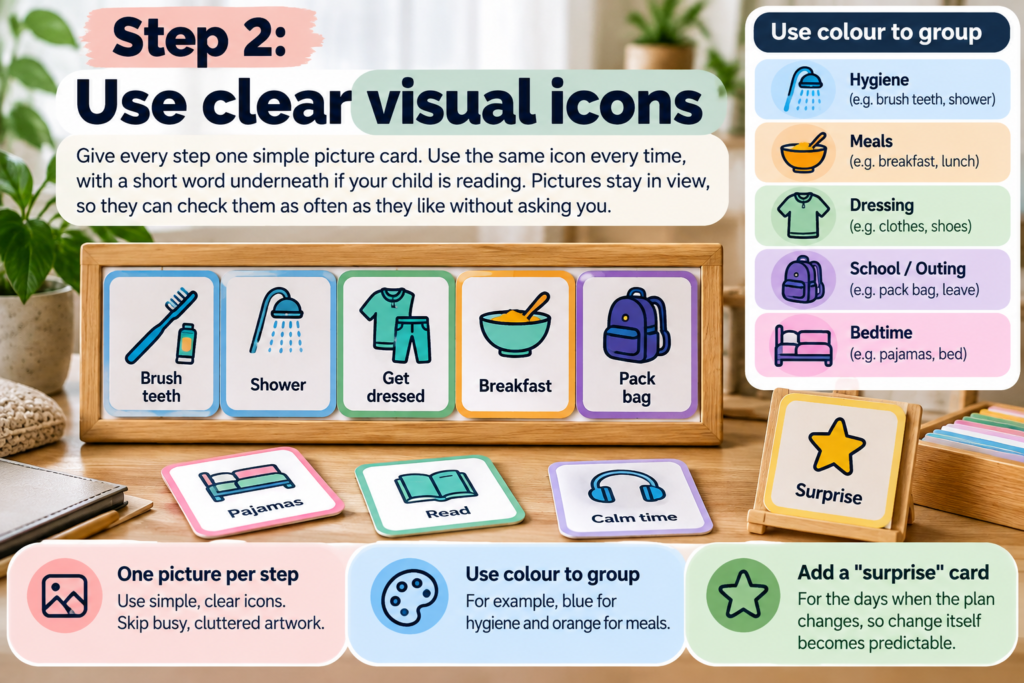
Give every step one simple picture card: a toothbrush, a backpack, a bowl, pajamas. Use the same icon every time, with a short word underneath if your child is reading. Pictures stay in view, so a child can check them as often as they like without asking you.
- One picture per step. Skip busy, cluttered artwork.
- Use color to group: for example, blue for hygiene and orange for meals.
- Add a “surprise” card for the days when the plan changes, so change itself becomes predictable.
Step 3: Move the card to the “Finished” box
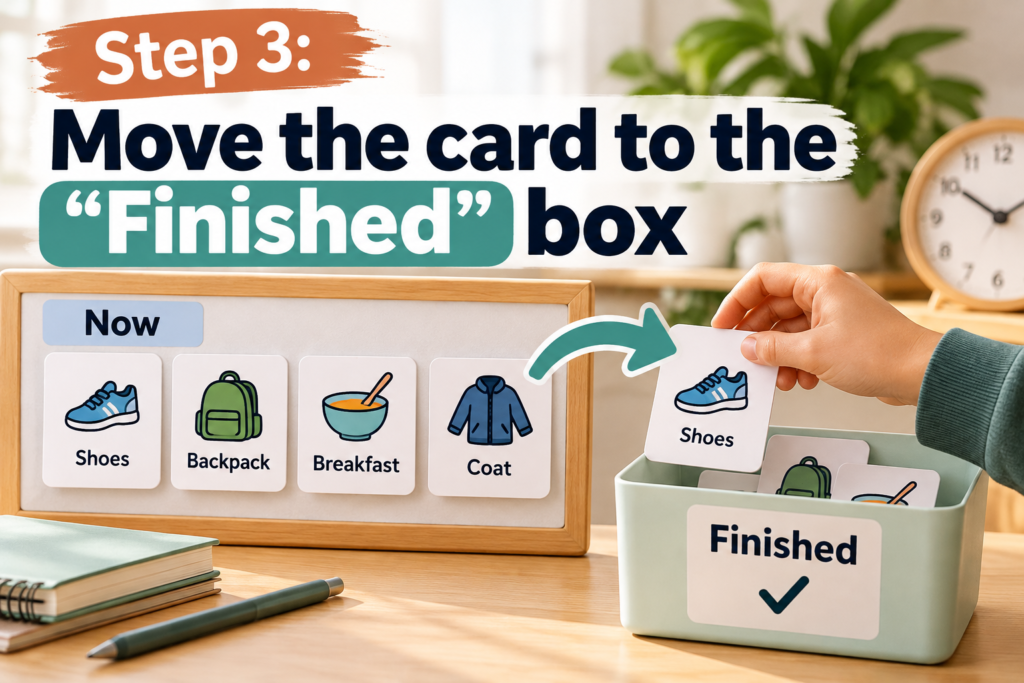
This is the step that turns the board from a poster into a tool. When an activity ends, your child physically picks up its card and drops it in the Finished box. That small action gives them control, marks a clear ending, and delivers a hit of accomplishment. It also builds behavioral momentum: each completed step makes the next one easier to start, the way a short run of easy wins makes the next task feel doable.
The physical part matters. Moving a card is something the child does, rather than something done to them. They stop being a passenger in the transition and become the one ending it.
A typical morning sequence looks like this:
- Child points to the next card on the board (“What’s next?”).
- You say one calm sentence: “Shoes.”
- When the step is done, the child moves the card to Finished.
- The board is empty by the time you leave, and that is the cue that it is time to go.
6 common mistakes that make transitions harder
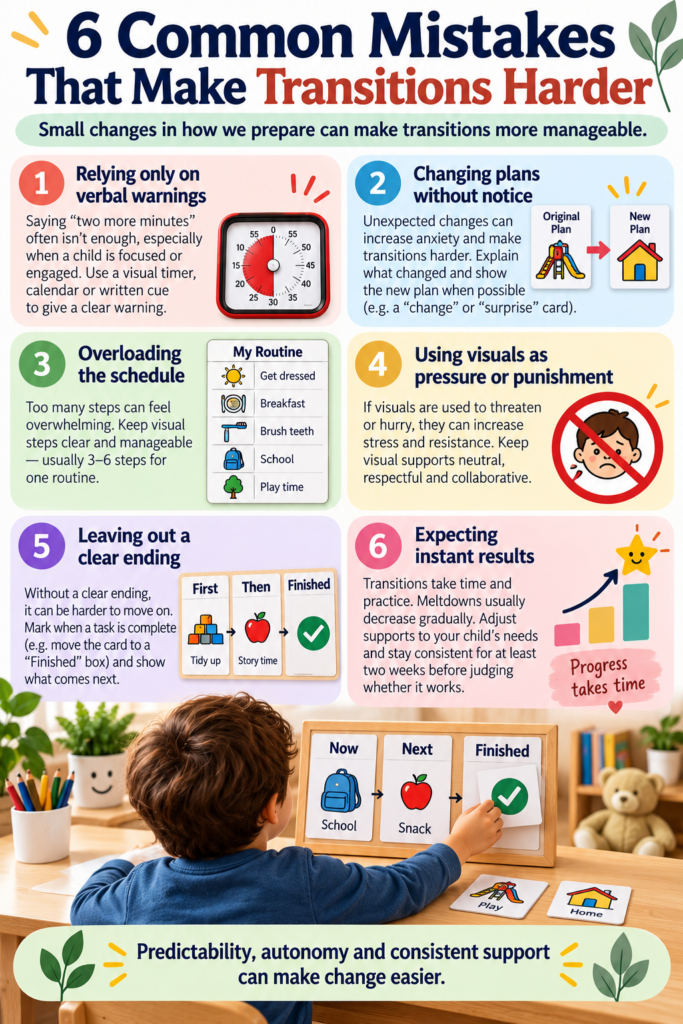
- Giving verbal warnings instead of visual cues. “Two more minutes!” disappears the second you say it, and a child deep in play often does not process it at all. Point to the board instead, or pair a visual timer with the card.
- Changing the order without a heads-up. If the schedule shifts constantly, the child learns the board cannot be trusted. Use a “surprise” card for real changes.
- Making too many cards. A board with 15 pictures overwhelms. Start with five or six.
- Using the board as a threat. “If you don’t hurry, I’m taking this card away” turns a tool for calm into a tool for punishment. Keep it neutral.
- Skipping the Finished box. Without the physical act of completion, the child loses the sense of control that makes the system work.
- Expecting perfection in week one. Meltdowns will drop gradually. Stay consistent for two weeks before judging whether it works.
Your first week, step by step

| Day | What to do |
|---|---|
| 1 | Pick one tricky routine. Print and cut the cards. Introduce the board during a calm moment, not mid-meltdown. |
| 2-3 | Walk through the routine together. Let your child move each card to the Finished box. |
| 4-5 | Step back. Point to the board instead of giving verbal reminders. |
| 6-7 | Celebrate. Let your child pick a new routine to add. |
Does it work for toddlers? Yes. Use three or four large picture cards and keep the board low enough to reach.
What if my child ignores the board? Make sure it sits at their eye level, near where the routine happens, and that you are not talking over it. Bring them to the board rather than calling from across the room.
How long will it take? Many families notice calmer transitions within one to two weeks of consistent use. Every child is different, so adjust the pace to yours.
Free download: the colorful printable matrix
Skip the drawing and the design work. The free printable pack includes everything you need to start tonight:
- A bright, ready-to-print routine board with a Now spot and a Finished box
- 12 colorful icon cards for morning, school, meals, play, and bedtime
- Blank cards to add your own steps
- A “surprise” card for plan changes
- A set of letter-size pages that print on any home printer
Download the free printable matrix here
Print it on cardstock, cut the cards, and stick on a little Velcro. If you laminate the pages, they will last for years.
References
- Knight, V., Sartini, E., & Spriggs, A. D. (2015). Evaluating visual activity schedules as evidence-based practice for individuals with autism spectrum disorders. Journal of Autism and Developmental Disorders, 45, 157–178.
- Center on the Developing Child at Harvard University. InBrief: Executive Function.
- Sayar, K., Gülboy, E., Yücesoy Özkan, Ş., & Baran, M. S. (2024). High-probability request sequence to increase compliance of children with autism spectrum disorder: A meta-analysis. Behavioral Disorders, 50(1), 17–33.
- Mouzakes, T. N., & Thompson, R. H. (2025). A closer examination of the visual schedule component of interventions to improve transitions.
Disclaimer:
The information provided on Autism Routine Hub is for educational and informational purposes only and is not intended as medical, behavioral, or psychological advice. While the strategies shared here are rooted in evidence-based practices, every individual is unique. This content should not replace professional consultation, diagnosis, or treatment from a qualified pediatrician, therapist, or healthcare provider. Always seek the advice of a specialist regarding any questions you may have about a medical or neurodivergent condition.
Leave a Reply