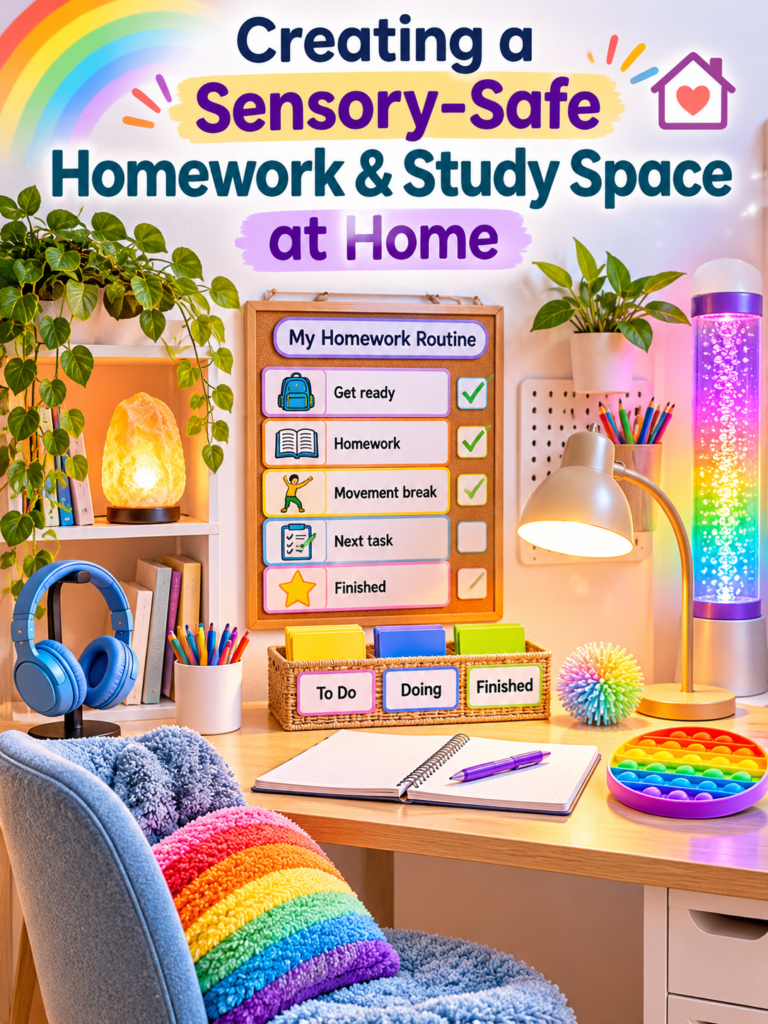
Part 2 of 3: Building Sensory-Supportive Learning Environments at Home
Homework can be challenging for many autistic children, particularly after a full day at school. By the time a child arrives home, they may have already processed hours of conversations, classroom noise, bright lights, social expectations and changes in routine.
Even when a child wants to complete their homework, their sensory system may be overwhelmed.
Sometimes the difficulty isn’t the homework itself. It is the environment in which the child is expected to complete it.
Creating a sensory-safe homework and study space can make learning more comfortable, predictable and manageable. A supportive environment does not need expensive furniture, specialist equipment or an entire room. Small, thoughtful adjustments can make a meaningful difference.
In this guide, we explore how parents and caregivers can create a personalised study environment that respects sensory preferences, supports concentration and encourages independence.
The Essentials of a Sensory-Safe Homework Space
1. Understand your child’s sensory needs before designing a sensory-safe homework space
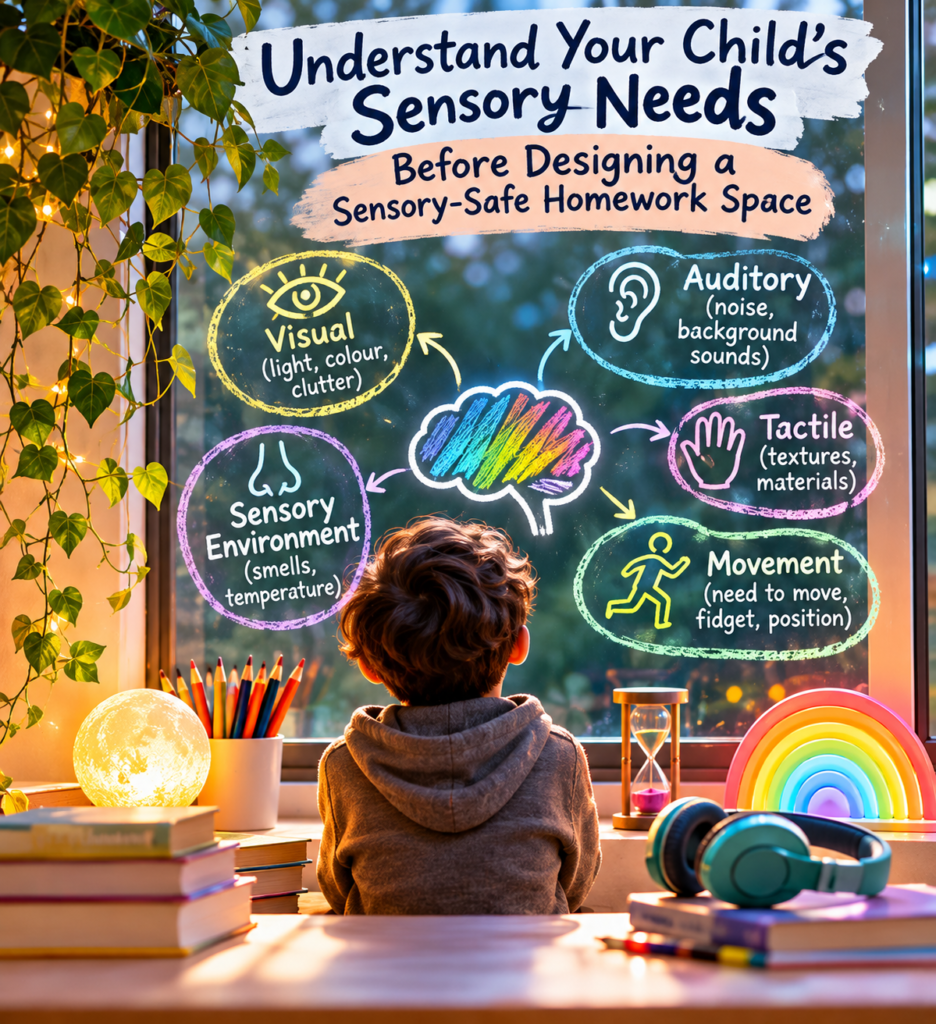
Every autistic child experiences sensory information differently. What feels calming to one child may feel uncomfortable or distracting to another.
Before purchasing furniture or organising a study corner, observe your child’s responses to the environment.
Consider these sensory areas:
Visual sensitivity
- Does your child become distracted by colourful walls, posters or clutter?
- Do bright overhead lights cause discomfort?
- Do they prefer a simple, uncluttered workspace?
Auditory sensitivity
- Are household conversations distracting?
- Does your child struggle when television or kitchen sounds are present?
- Would a quieter room or optional ear defenders help?
Tactile preferences
- Does your child dislike particular chair materials or clothing textures?
- Do they prefer a soft cushion or a firm chair?
- Are certain stationery materials uncomfortable?
Movement and body awareness
- Does your child find sitting still difficult?
- Do they concentrate better when standing?
- Would short movement breaks help?
The purpose of observation is not to eliminate every sensory experience. It is to identify environmental barriers and make reasonable adjustments.
2. Choose the right location for homework
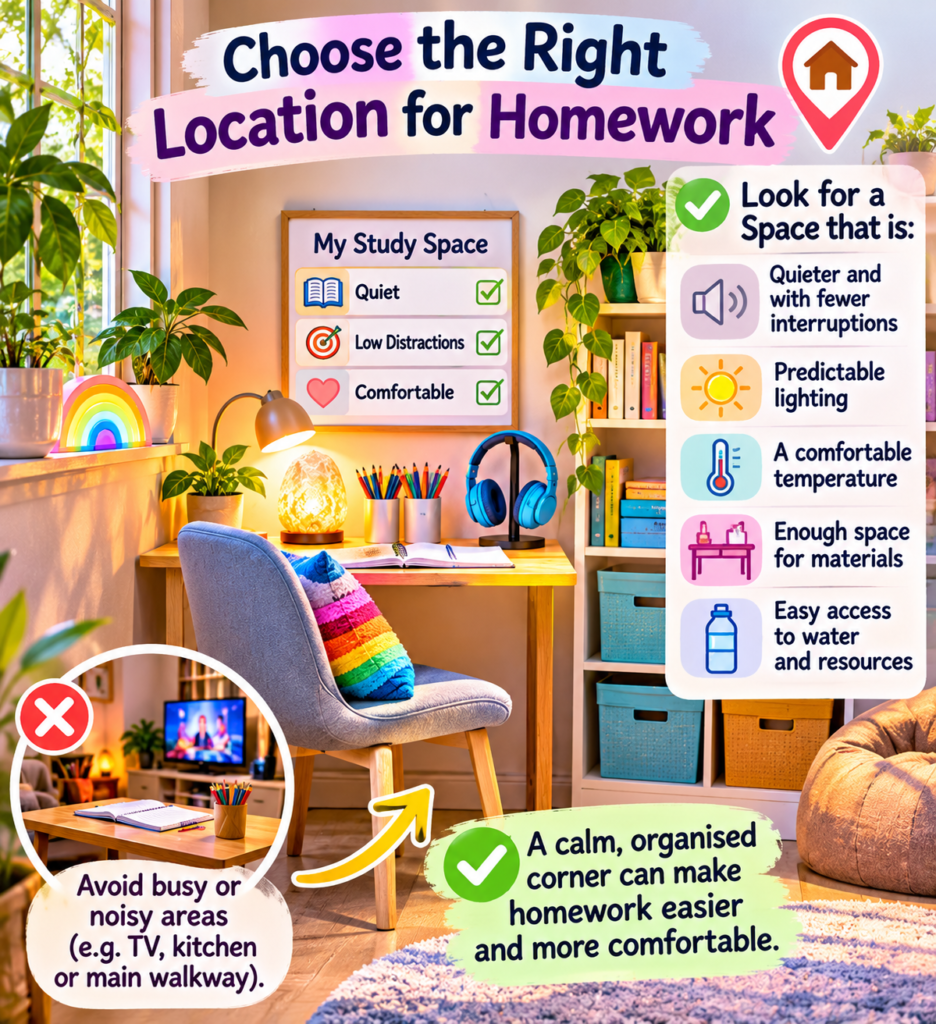
You do not necessarily need a separate study room.
A small corner of a bedroom, a quiet section of the living room or a dedicated table can become a functional learning space.
Look for a location that offers:
- Fewer interruptions.
- Predictable lighting.
- A comfortable temperature.
- Enough space for essential materials.
- Easy access to water and learning resources.
Avoid placing the study area directly beside a television, busy kitchen or frequently used doorway if these create distractions.
However, some children prefer studying near a parent or caregiver. Being close to a trusted adult can provide reassurance.
The best location is the one that supports your child’s comfort and participation.
3. Create a visually calm workspace
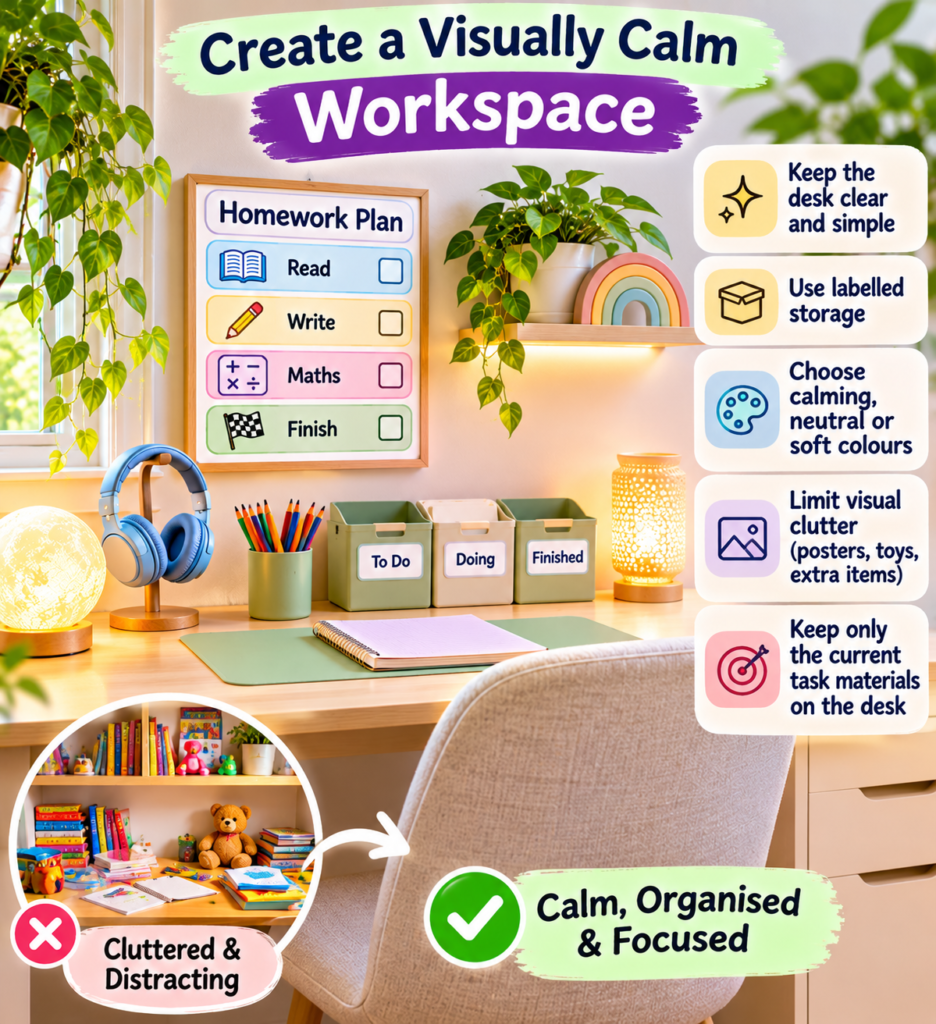
Visual clutter can make it harder for some children to identify what they need to focus on.
A simple workspace can help reduce unnecessary visual distractions.
Try these adjustments:
- Keep only the current homework materials on the desk.
- Store additional books and stationery in labelled containers.
- Use simple colour-coded folders.
- Avoid overcrowding the walls with posters.
- Provide a clear space for completed work.
Consider using a small tray with three sections:
To Do | Doing | Finished
This can help children understand where each task belongs and make progress more visible.
A visual organisation system can be particularly useful for children who benefit from predictable routines.
4. Pay attention to lighting and sound
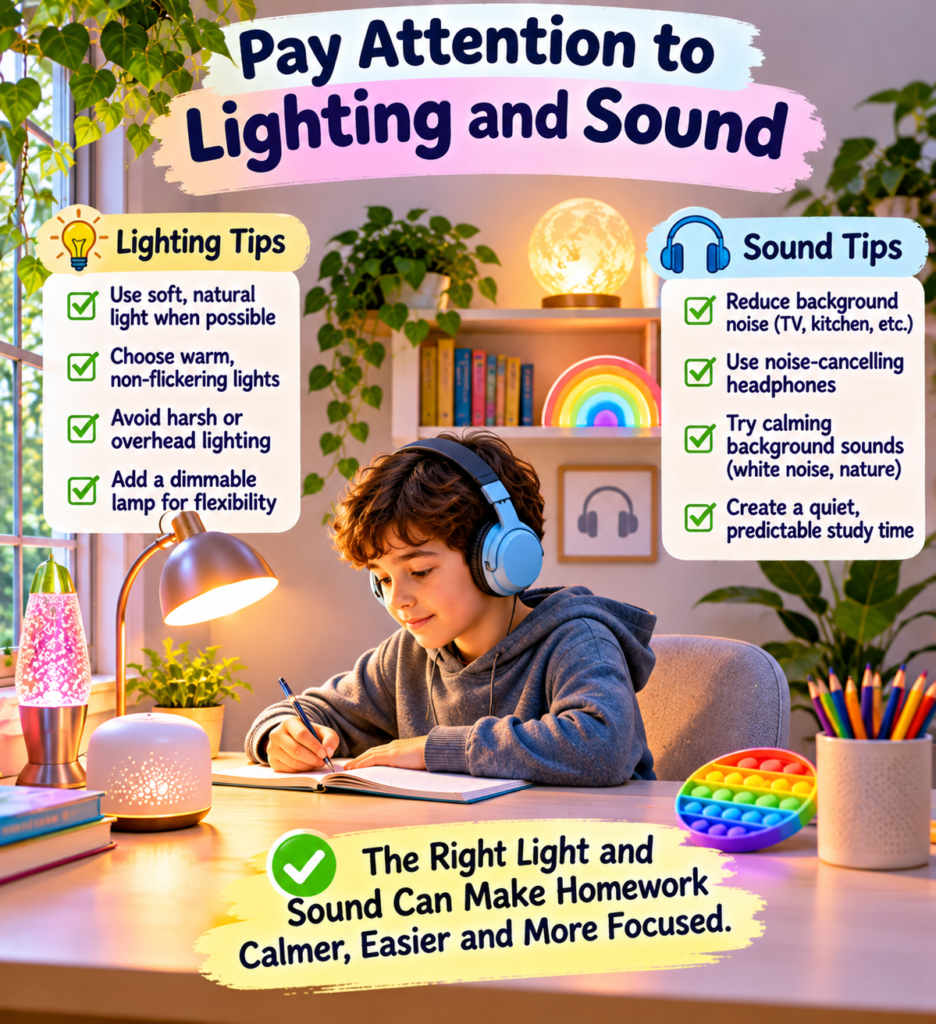
Lighting and sound are often overlooked when creating a homework environment.
Some children find fluorescent lighting uncomfortable, while others may be distracted by shadows, glare or flickering lights.
Where possible:
- Use natural daylight without direct glare.
- Consider a suitable adjustable desk lamp.
- Avoid unnecessarily harsh lighting.
- Allow your child to communicate lighting preferences.
Sound is equally important.
You might consider:
- Moving the workspace away from noisy appliances.
- Turning off unnecessary background television.
- Offering optional ear defenders.
- Providing a quieter period for homework.
Do not assume that every autistic child needs silence. Some children prefer gentle background sounds, while others find them distracting.
Follow the child’s individual preferences.
5. Make seating and movement flexible
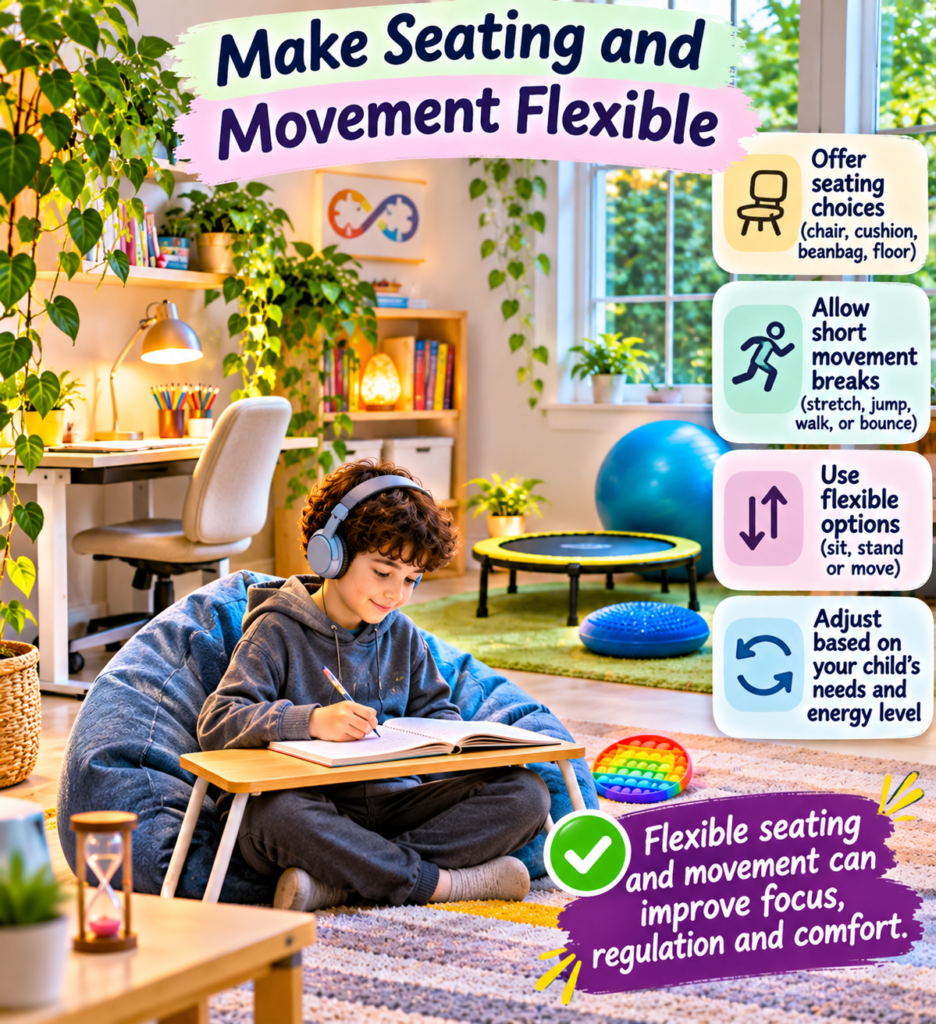
A traditional desk and chair are not the only ways to complete homework.
Some children work comfortably at a desk, while others may prefer a standing position, floor cushion or alternative seating arrangement.
Consider:
- A chair with appropriate support.
- A footrest if needed.
- A standing option.
- Space for safe movement.
- Short opportunities to stretch between tasks.
Movement should not automatically be treated as a distraction.
For some children, movement is part of how they regulate their bodies and maintain attention.
The objective is to provide a safe and comfortable way to participate in learning.
6. Organise materials using TEACCH-inspired principles
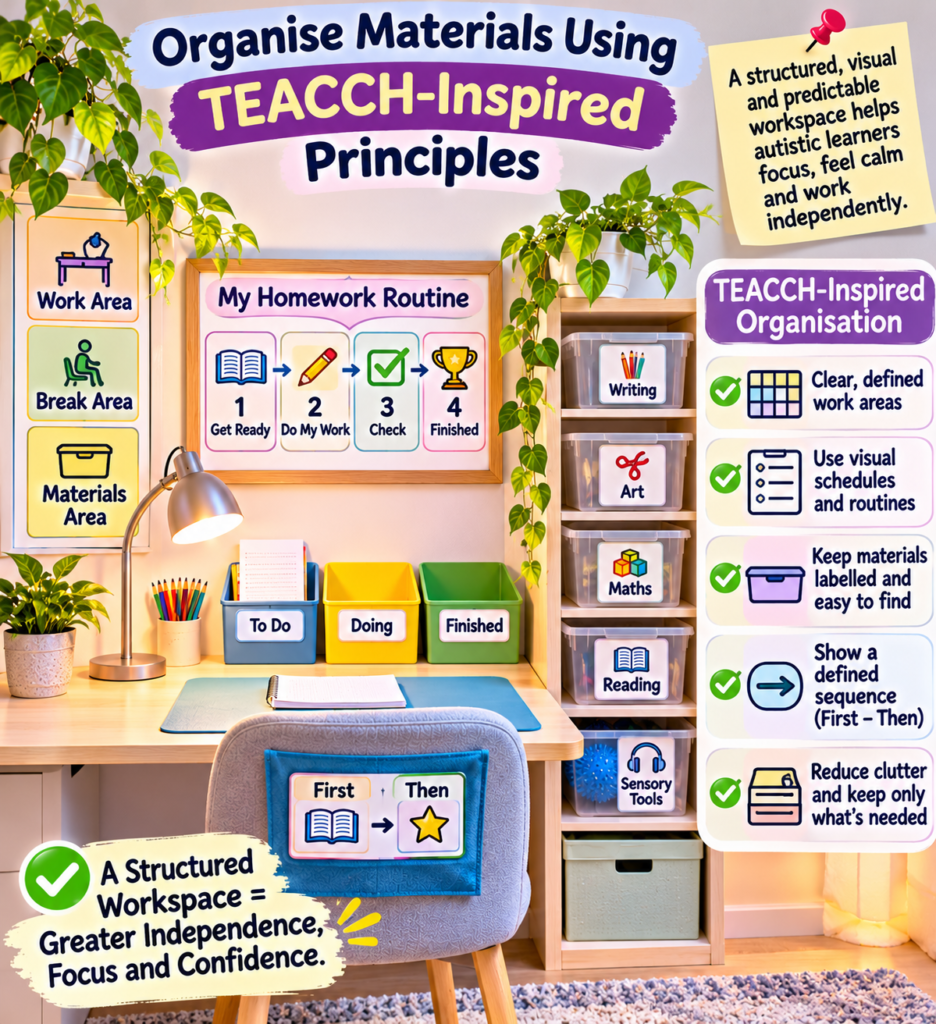
The TEACCH approach emphasises structured environments, visual organisation and clear expectations.
These principles can be adapted to a home homework space.
Consider four simple questions:
What work needs to be completed?
Use a visual checklist or homework planner.
How much work is expected?
Break larger assignments into smaller, manageable sections.
How will my child know when the task is finished?
Use a finished box, tick chart or completed-work folder.
What happens next?
Show the next activity, movement break or preferred activity using a visual schedule.
For example:
- Reading worksheet.
- Short break.
- Mathematics activity.
- Put materials away.
- Preferred activity.
This structure helps make the homework routine more predictable.
Remember that visual supports should be individualised. Some children benefit from photographs, others from simple illustrations, written instructions or objects.
7. Introduce a low-pressure homework routine
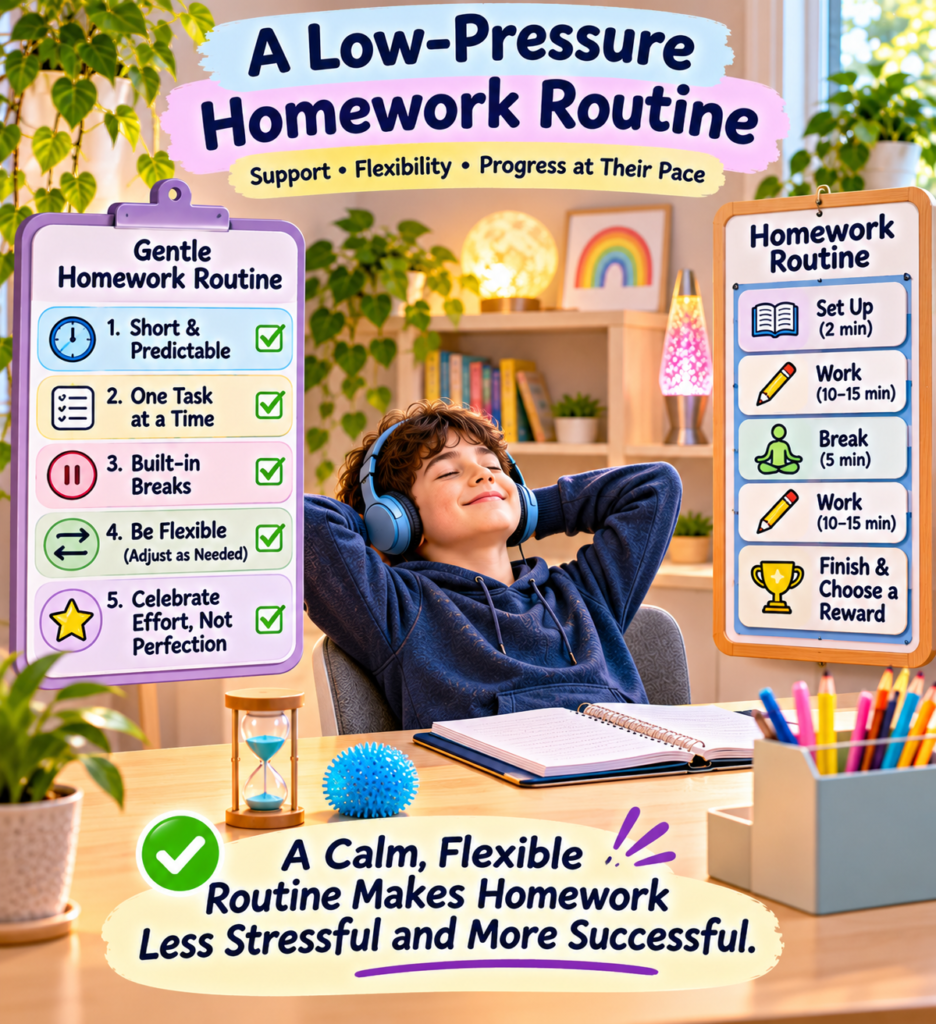
One of the biggest mistakes families make is expecting children to begin homework immediately after returning from school.
Some children need time to decompress before they can participate in another structured activity.
A more supportive sequence might look like this:
| Stage | Activity |
| Arrival | Change clothes and settle |
| Recovery | Quiet time or preferred activity |
| Preparation | Snack, water and movement |
| Homework | One manageable task |
| Break | Stretch, walk or relax |
| Completion | Finish remaining work |
| Transition | Preferred evening activity |
The timing should depend on the child’s individual needs.
Some children may manage short work periods, while others need longer recovery time or additional support.
A successful homework routine is not necessarily one in which every task is completed at once. It is one that supports participation without creating unnecessary distress.
8. Recognise signs of sensory overload
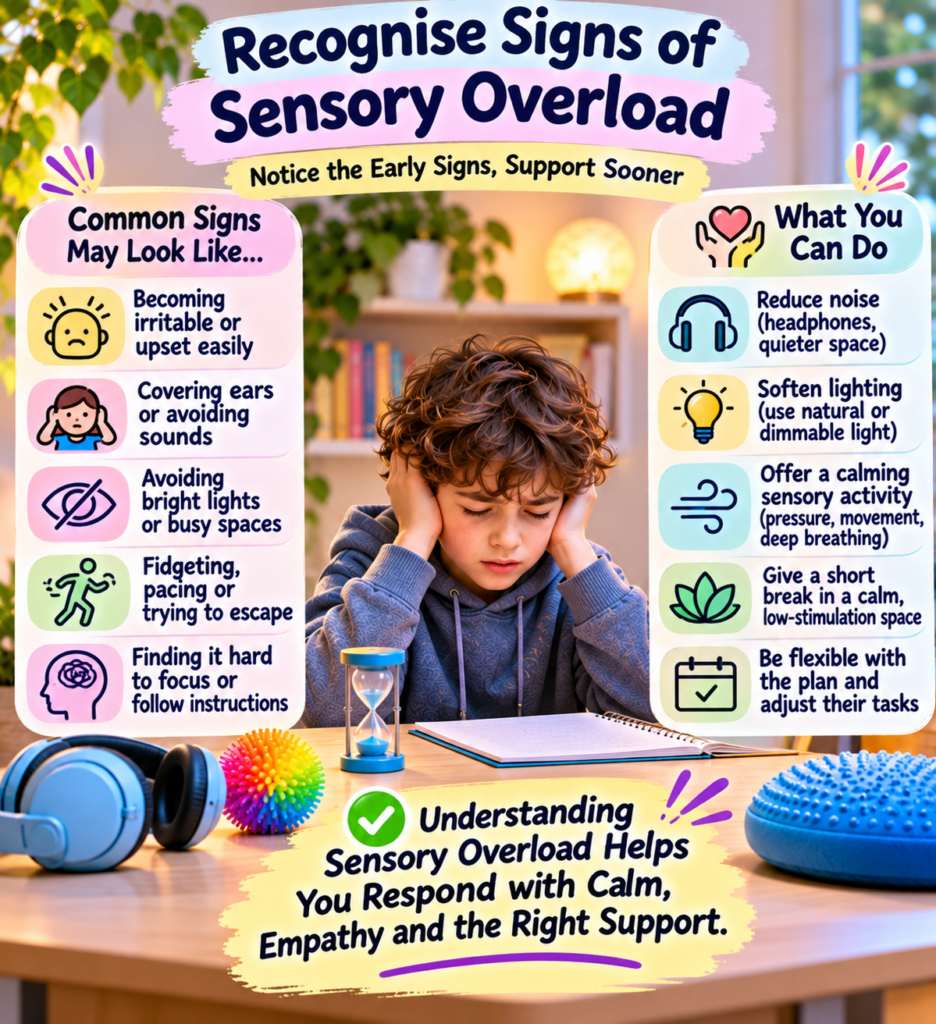
Sometimes a child may struggle to communicate that the study environment is becoming overwhelming.
Look for possible changes such as:
- Increased restlessness.
- Covering ears or eyes.
- Avoiding the workspace.
- Becoming unusually quiet.
- Increased frustration.
- Difficulty following familiar instructions.
- Repeatedly leaving the study area.
These behaviours may have different explanations, including fatigue, task difficulty, communication barriers or sensory discomfort.
Rather than immediately insisting that the child return to the desk, pause and consider what might be making the situation difficult.
Reduce demands when appropriate, offer a break and make adjustments.
A supportive learning environment should never depend on forcing a child to tolerate discomfort.
9. A simple example of a sensory-safe homework corner
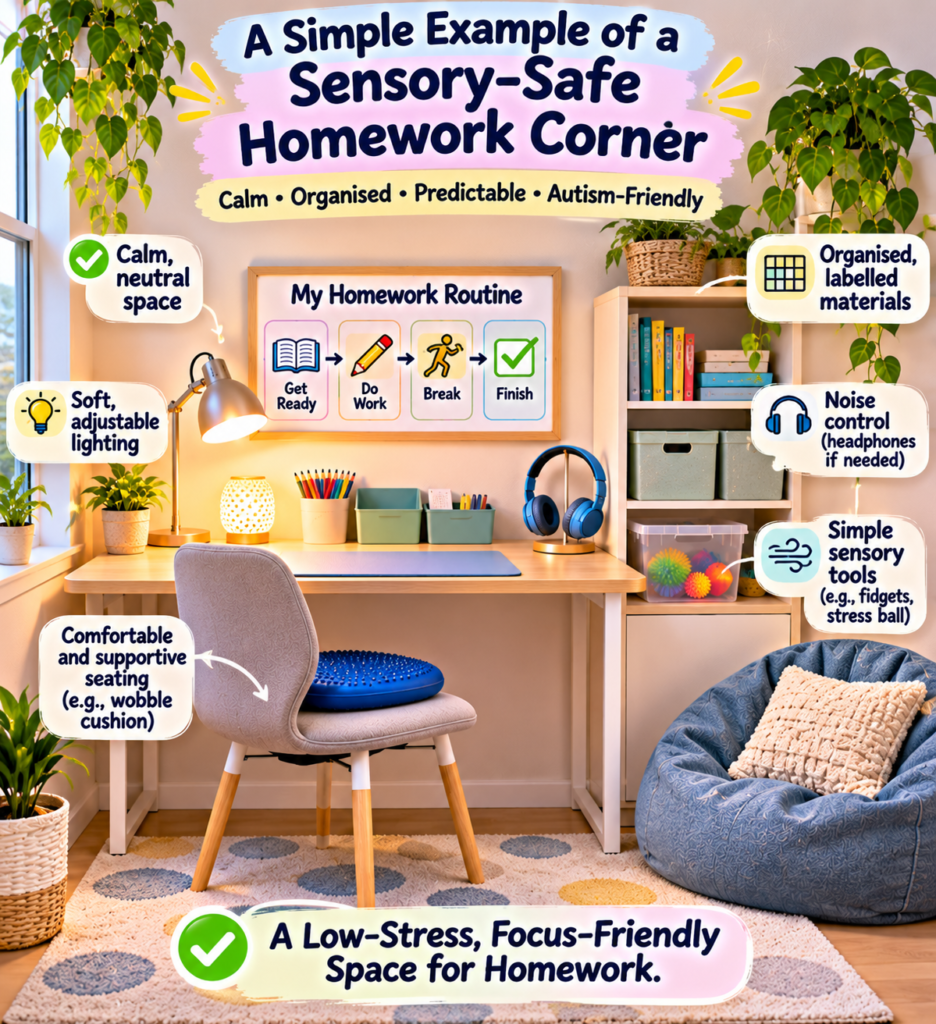
Imagine a small corner of a family living room.
It contains:
- A simple desk with minimal visual clutter.
- A comfortable chair.
- A small storage tray for stationery.
- A visual homework checklist.
- A labelled finished-work box.
- An adjustable lamp.
- A nearby space for movement breaks.
The child knows where to find their materials, what task comes first and what happens after completing the work.
The environment is predictable but flexible.
Most importantly, the child has opportunities to communicate preferences and participate in organising their own workspace.
10. Remember: The goal is comfortable learning, not perfect behaviour
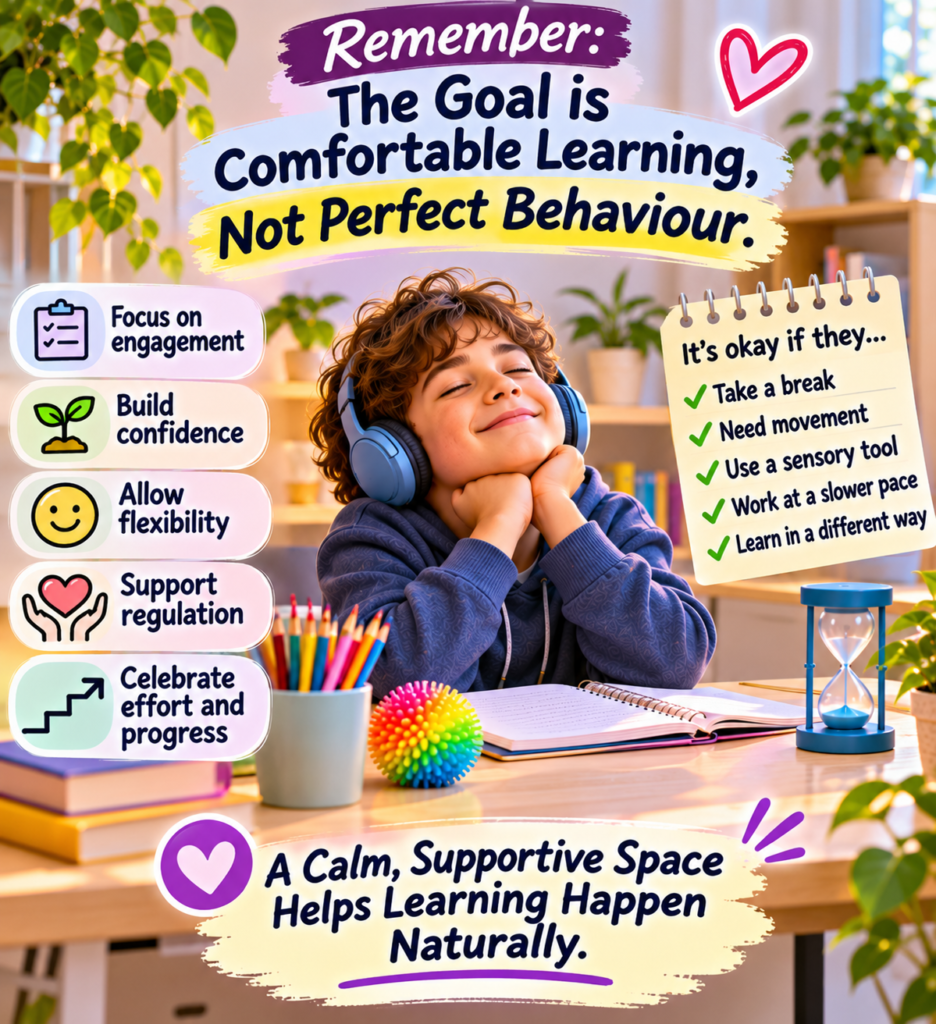
A sensory-safe homework space is not about making every child sit quietly, remain still or complete homework without assistance.
It is about identifying barriers, supporting communication and making learning more accessible.
Some days your child may complete several tasks independently. On other days, they may need more support, shorter activities or additional recovery time.
Progress should be measured by meaningful participation, comfort and growing independence rather than simply by how long a child sits at a desk.
Download Your Free Sensory-Safe Study Space Planner
Creating the right environment can feel overwhelming when you are unsure where to begin.
To make the process easier, we have prepared a colourful, printable three-page planner for parents and caregivers.
Inside the planner:
- Sensory-safe study space checklist.
- Lighting, sound and seating preferences.
- Personalised workspace planning sheet.
- Homework routine visual sequence.
- Daily mini homework planner.
- Break and support planning.
Use the pages to identify your child’s preferences and make gradual adjustments at home.
Remember: You do not need to change everything at once. Start with one adjustment and observe how your child responds.
Final Thoughts
Every autistic child deserves an opportunity to learn in an environment that recognises their individual needs.
A quiet corner, a predictable visual schedule, comfortable seating or a simple finished-work box may seem like small changes. However, these adjustments can help make everyday learning more manageable.
Start with your child. Observe, listen, adapt and review.
At Autism Routine Hub, we believe that supportive environments should be built around the individual, not the other way around. With these simple adjustments, your child will have a sensory-safe homework space that supports consistent focus.
References & Resources:
- Enabling Devices: Sensory Rooms: The Complete Guide (https://enablingdevices.com)
- Autism Routine Hub: Explore our complete Sensory-Supportive Learning Series (https://theautismroutinehub.com)
Disclaimer:This article provides general educational information and is not a substitute for individualised professional guidance.
Continue the series: Explore Part 1 of our Sensory-Supportive Learning at Home series and look out for Part 3, where we will continue exploring practical ways to support autistic learners at home.
Leave a Reply