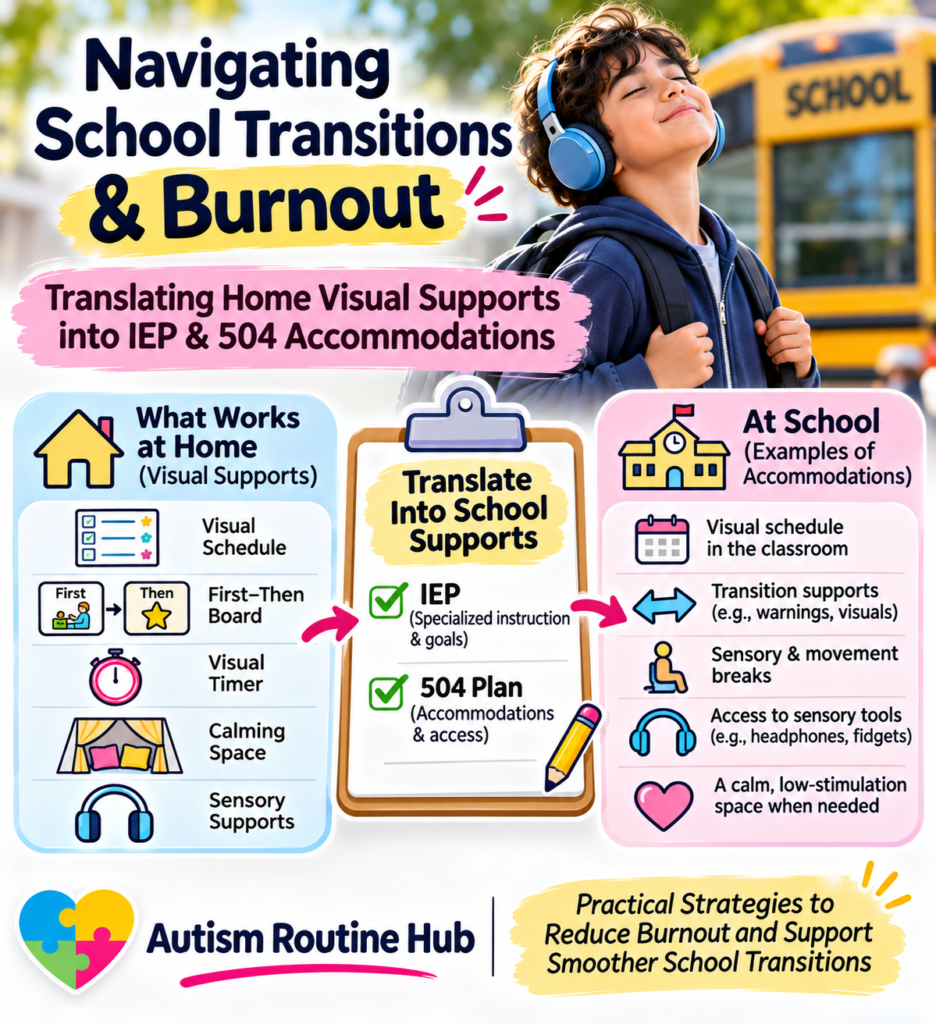
The picture schedule that gets your child through the morning at home can do the same job at school, especially when managing school transitions burnout.
This is Part 3 of a 3-part series on helping children get through school transitions without burning out. Part 2 covered the home side, a sensory-safe homework and study space. Here we turn to the bigger structural piece: advocating for long-term solutions by getting the supports that already work at home into the IEP or 504 plan.
Transitions are where unsupported children run out of energy fastest. A new room, a new teacher or a new routine means extra effort all day, and without familiar visual cues that effort piles up into the exhaustion and shutdowns people call burnout. A written accommodation is the first line of defense.
Why a support that works at home prevents school transitions burnout
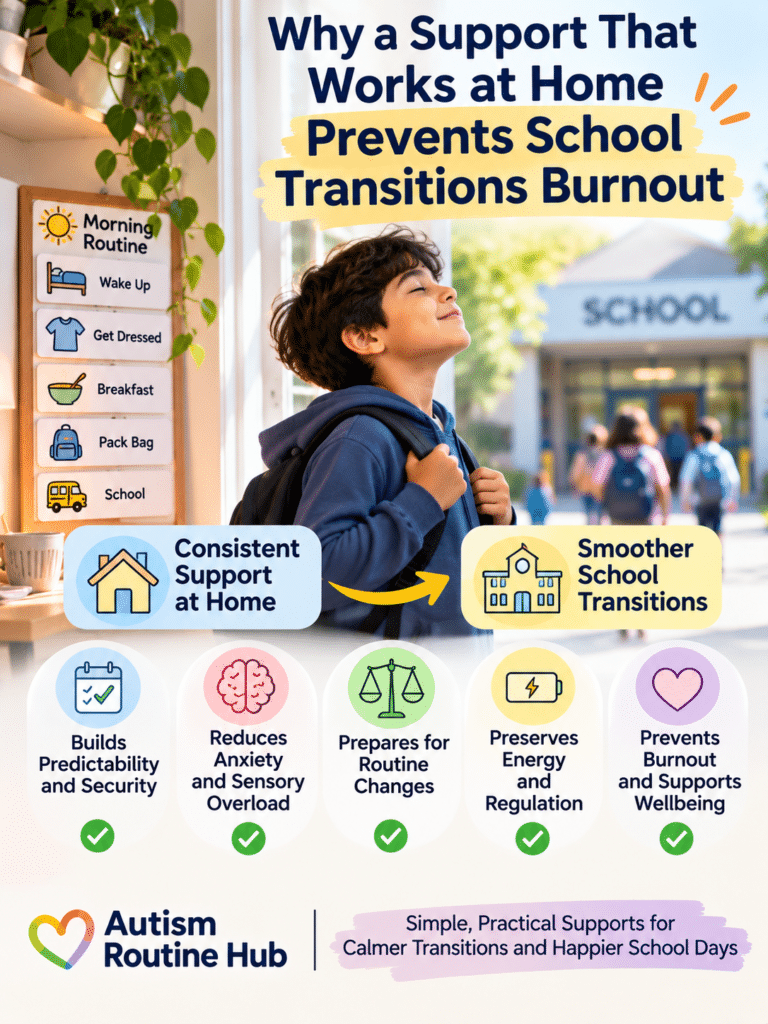
If your child uses a first-then board, a visual timer or a picture checklist at home, you already hold the best evidence a school team could ask for: proof that a specific support changes behavior, transitions or independence.
Schools, however, act on what is written. A support mentioned in passing at a meeting depends on one teacher’s memory. A support written into the plan travels with your child to the next grade, a substitute teacher and the next case manager.
The goal of this post is to show you how to move from “this works at home” to “this is a documented, measurable accommodation.”
IEP or 504: which plan are we writing into?
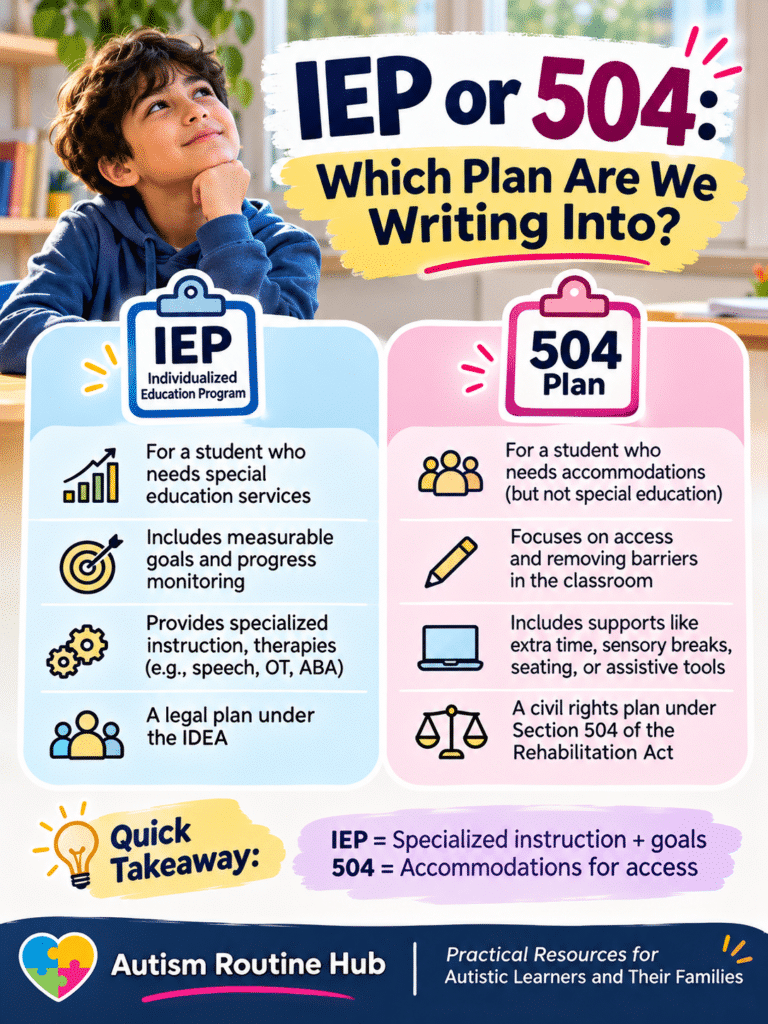
Visual supports can go into either plan. What differs is the law behind it and how much the plan can include. (This post assumes a US school; rules differ elsewhere.)
| IEP | 504 Plan | |
|---|---|---|
| Law | Individuals with Disabilities Education Act (IDEA) | Section 504 of the Rehabilitation Act |
| Who qualifies | A child with a listed disability whose condition affects learning enough to need specialized instruction | A child with a disability that limits a major life activity, such as learning or communicating |
| What it provides | Specialized instruction, related services, goals, accommodations | Accommodations and supports in the general classroom |
| Written goals | Yes, measurable annual goals | Not required |
| Where visual supports appear | Accommodations, supplementary aids, and often goals (for example, “uses a visual schedule to transition independently”) | Accommodations list |
If your child is on an IEP, you can tie a visual support to a goal so progress is tracked. On a 504, the accommodation itself needs to be specific, since there is no goal section to carry the detail.
Step 1: Document what works at home

Before you draft any wording, spend two weeks gathering evidence. Teams respond to specifics, not general impressions.
- Photograph the support. A picture of the schedule, timer or choice board shows the team exactly what it looks like, so they can copy it.
- Note the trigger. Write down what the support addresses: transitions, morning routine, homework start, meltdowns when plans change.
- Record the before and after. For example, “Getting out the door took 40 minutes with repeated prompts. With the picture checklist it takes 15, with one verbal reminder.”
- List how it is introduced. Who sets it up, when it appears, how it is faded or changed.
- Capture the level of prompting. Does your child use it alone, with a gesture, or with a verbal cue? This becomes the baseline for a goal.
Step 2: Translate the support into plan language
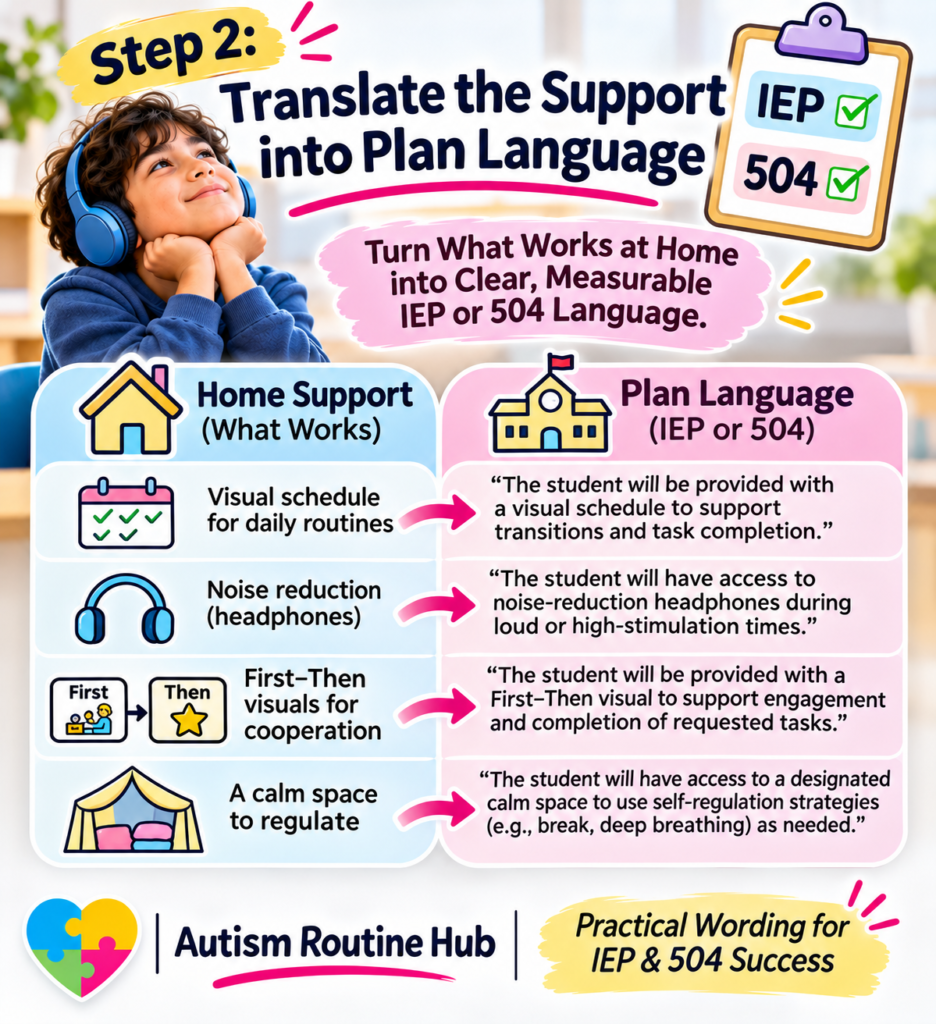
A good accommodation names the support, says when it is used, says who provides it, and can be checked. “Visual supports as needed” fails all four tests. Use the table below as a starting point and adapt the wording to your child.
| At home | Classroom accommodation | Sample plan wording |
|---|---|---|
| Picture schedule on the fridge | Individual visual schedule at the desk or on a classroom wall | “Student will be provided an individual visual schedule of the daily routine, reviewed with an adult at the start of each day and updated for any changes.” |
| First-then board | First-then cards for non-preferred tasks | “Staff will use a first-then visual to introduce non-preferred tasks, with the preferred activity shown and available after task completion.” |
| Visual timer | Timer for work periods and transitions | “Student will have access to a visual timer for independent work and transitions, with a 2-minute warning before each change.” |
| Picture checklist for routines | Step-by-step task checklist for arrival, packing up and multi-step assignments | “Multi-step tasks will be broken into a visual checklist that the student marks off independently.” |
| Choice board | Choice board for breaks and communication | “Student will have access to a visual choice board to request a break or select between two options.” |
| Social story or visual rules | Visual expectations for specific settings (lunch, assemblies, fire drills) | “Staff will preview a visual of expectations before new or unstructured settings and unexpected events such as drills.” |
Three habits make the wording stronger:
- Say how often and where. “Daily, in all classroom settings” beats “as needed.”
- Name who is responsible. The classroom teacher, a paraprofessional or the special education case manager.
- Add a fading plan if appropriate. For example, move from a full-day schedule to a checklist of key steps as independence grows. If you want the support to remain, say so.
Step 3: Prepare for the meeting
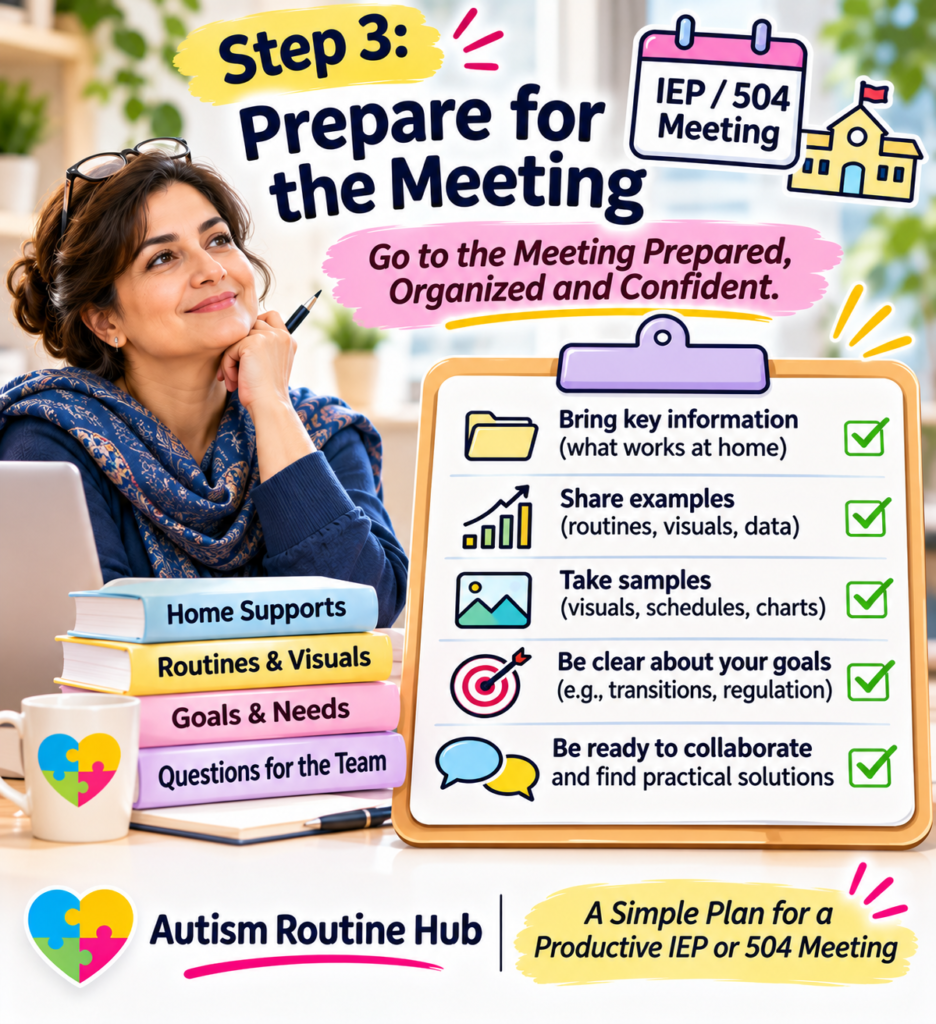
Send your request in writing a week or so before the meeting, so the team can read it and bring questions rather than reacting on the spot.
- Bring a one-page summary. Include the photos, the before-and-after notes and your proposed wording from Step 2.
- Lead with the problem, then the support. “Transitions to lunch lead to distress most days. At home, a visual timer plus a first-then card cut that sharply. We’d like to try the same at school.”
- Ask for a trial, not a debate. Propose a set period, such as six weeks, with a data check-in afterward.
- Share the materials. Offer to provide the same symbols or app you use at home, so your child sees consistent pictures in both places.
- Expect questions about staffing and logistics. Have an answer for who will update the schedule and how it will be stored. A realistic plan is more likely to be adopted.
You are a full member of the IEP team. If something is proposed that you do not agree with, you can ask for time to review it before signing.
Step 4: Make sure it is carried out
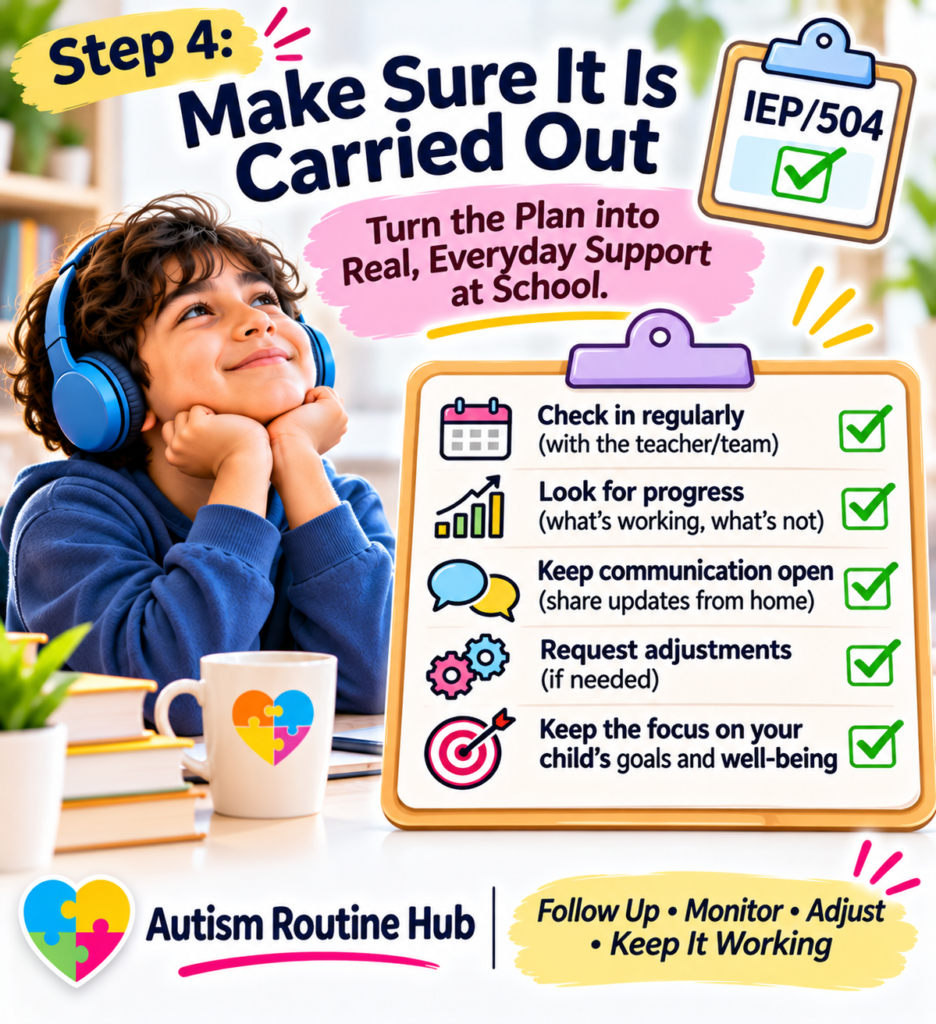
A signed plan is a starting line. Most breakdowns happen in the first month, when the people who attended the meeting are not the people running the classroom.
- Ask that every adult who works with your child gets the plan. That includes specials teachers, the lunch and recess staff, and any substitute.
- Visit or request a photo. Seeing the schedule on the wall confirms it is actually in use.
- Set a simple data point. For instance, “number of transitions needing more than one verbal prompt per day,” tracked by staff and shared every two weeks.
- Use a communication log. A short daily note or shared form keeps both sides aligned.
- Request a review if it is not working. You do not need to wait for the annual meeting. You can ask the team to reconvene in writing at any time.
If the support is not being provided as written, raise it first with the teacher and case manager, then with the school administrator. Keep copies of your emails.
Common pitfalls
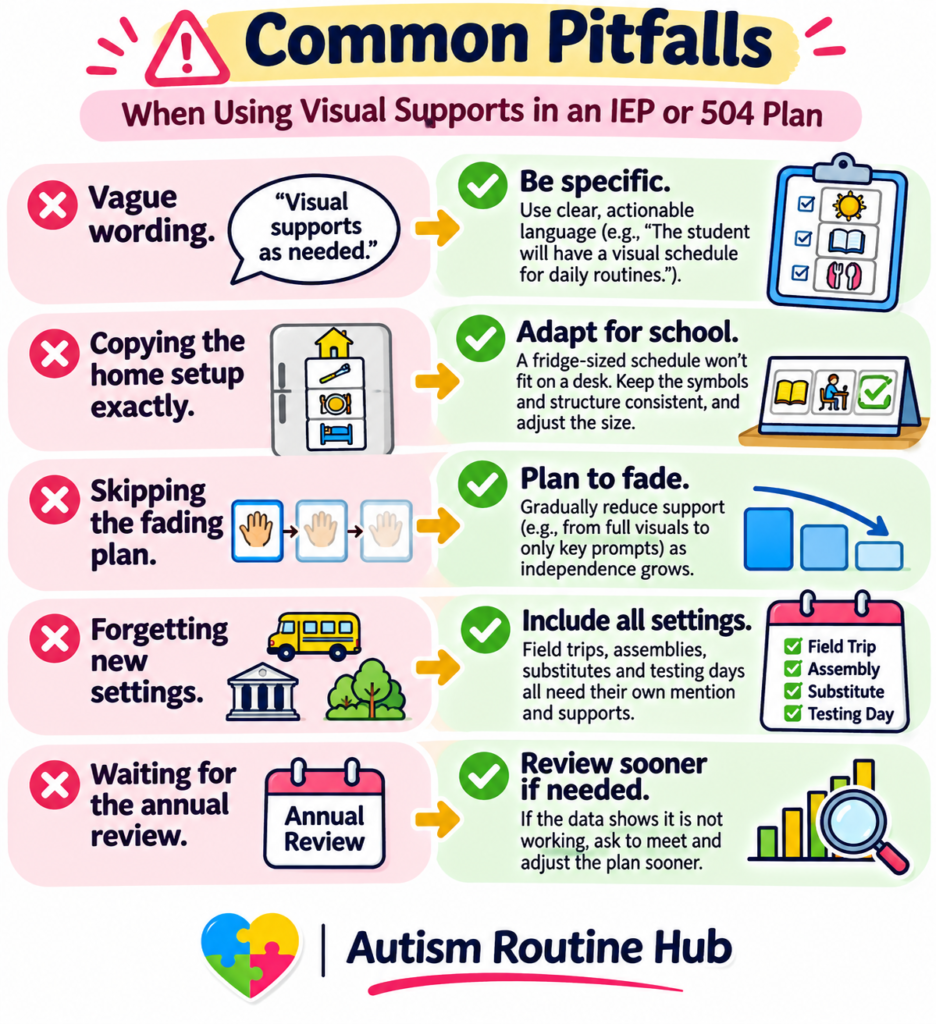
- Vague wording. “Visual supports as needed” is hard to enforce and easy to skip.
- Copying the home setup exactly. A fridge-sized schedule will not fit on a desk. Keep the symbols and structure consistent, and adapt the size.
- Skipping the fading plan. Without one, supports can linger past their usefulness or vanish too early.
- Forgetting new settings. Field trips, assemblies, substitutes and testing days all need their own mention.
- Waiting for the annual review. If the data shows it is not working, ask to meet sooner.
A final word
You have already done the hardest part: finding what helps your child. Translating it into plan language is a matter of being specific, documenting the results and asking for a short trial with a clear check-in. Keep your records, keep the pictures consistent between home and school, and your child gets the same clear signals in every room.
This post is general information, not legal advice. For questions about your child’s rights, contact your state’s parent training and information center or a special education advocate.
Also in the series
- Part 2: Creating a Sensory-Safe Homework and Study Space at Home
- Part 3: Navigating IEPs and 504 Plans: How to Translate Home Visual Supports into Classroom Accommodations
References
- Rawe, J. (2026, March 12). The difference between IEPs and 504 plans. Understood. https://www.understood.org/en/articles/the-difference-between-ieps-and-504-plans
- Pillai, R., & Branch, J. M. (2026, July 9). IEPs and 504 plans: A guide for parents. HealthyChildren.org, American Academy of Pediatrics. https://www.healthychildren.org/English/health-issues/conditions/developmental-disabilities/Pages/Individualized-Education-Program.aspx
Disclaimer
The information provided in this article is for educational and informational purposes only. It is not intended to replace professional advice, individualized educational assessments, medical guidance, or legal advice.
Every autistic child has unique strengths, needs, communication styles, and sensory preferences. Strategies and visual supports that work for one child may not work for another. Parents and caregivers are encouraged to adapt suggestions to their child’s individual needs and consult qualified professionals and school teams when developing educational supports.
IEP and Section 504 eligibility, procedures, and protections vary according to applicable laws and educational systems. The information about IEPs and 504 Plans in this article refers primarily to the United States education system.
Autism Routine Hub does not guarantee specific educational outcomes. Our aim is to share practical, respectful, strengths-based resources that help families and educators create supportive environments for autistic learners.
© Autism Routine Hub | Educational resources for families, caregivers, and educators.
Leave a Reply