If you are in immediate danger or have seriously hurt yourself, contact your local emergency number or go to the nearest emergency department. To find a crisis line in your country, visit findahelpline.com.
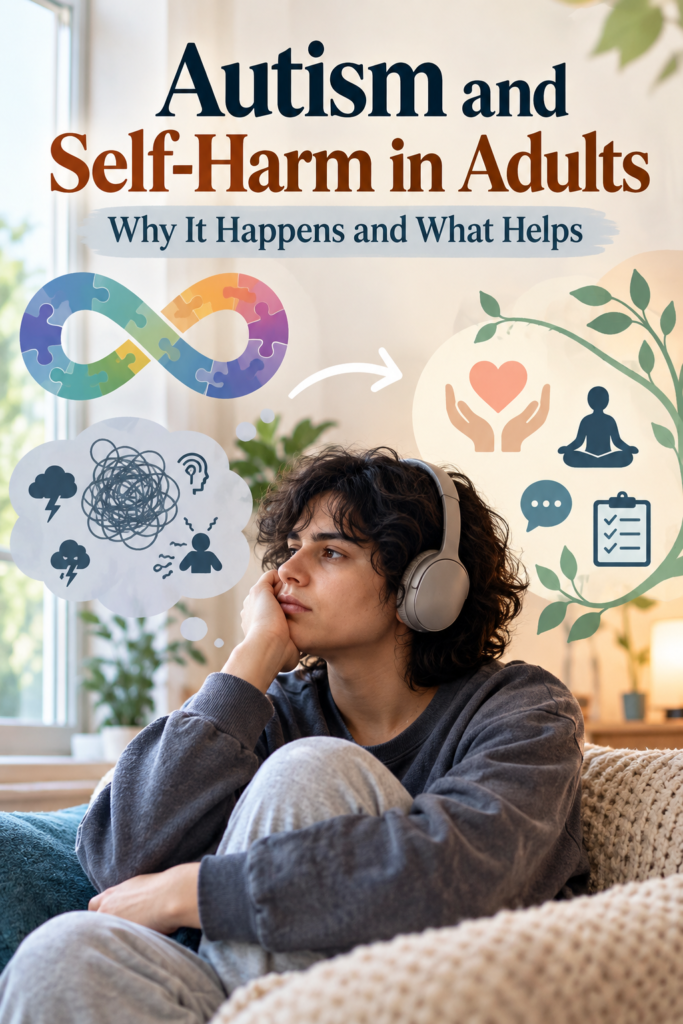
Self-harm among autistic adults is often misunderstood as attention-seeking, manipulation, or “difficult behavior.” In reality, it is frequently a sign of overwhelming distress: sensory overload, anxiety, depression, trauma, burnout, or needs that have not been recognized or supported.
Self-harm is not a moral failure. It is often a sign that someone is in pain and does not have enough safety, support, or ways to say so. This guide uses “self-harm” and “self-injury” to mean the same thing.
What Self-Injury Can Look Like
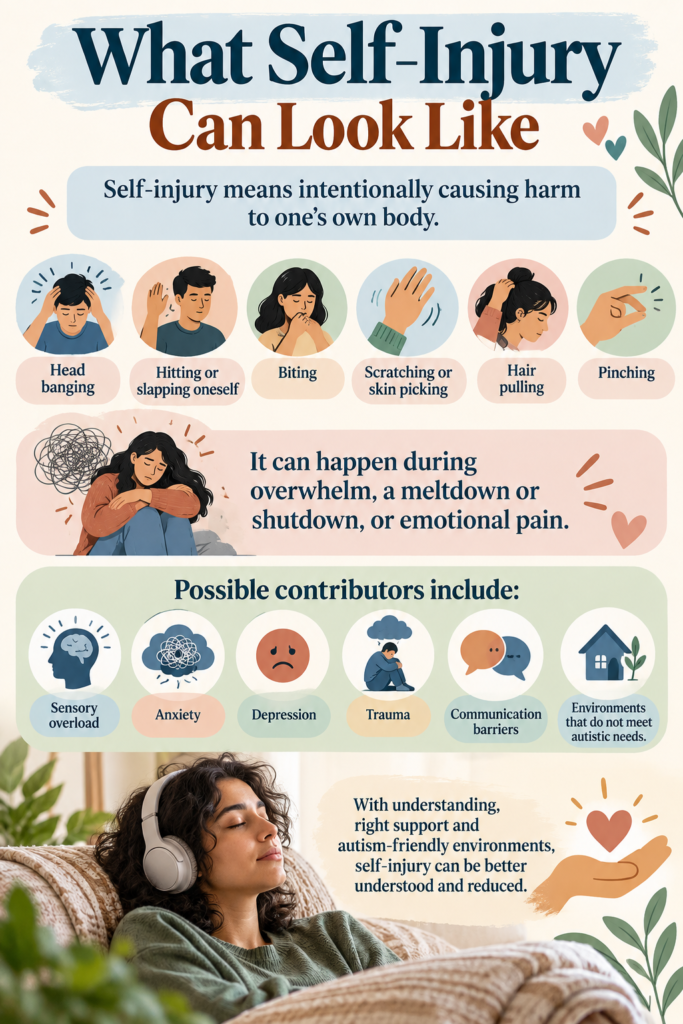
Self-injury means intentionally causing harm to one’s own body. In autistic adults, it may include head banging, hitting or slapping oneself, biting, scratching, skin picking, hair pulling, or pinching.
It does not look the same for everyone. Some autistic adults injure themselves during a meltdown or shutdown, while others do so privately during emotional pain. It can be connected to sensory overload, anxiety, depression, trauma, communication barriers, and environments that are not designed for autistic needs.
Self-injury is common in autism. [One large review] of 37 studies estimated that around 42% of autistic people have self-injured, with higher rates in females.
This review covers all ages and includes people with intellectual disability, so I kept the wording general.
Why It Happens
- Sensory overload: Noise, bright lights, crowds, heat, unexpected touch, or too many demands can overwhelm the nervous system.
- Emotional distress: Anxiety, depression, grief, loneliness, shame, and trauma can build until coping feels impossible.
- Meltdowns and shutdowns: During extreme overwhelm, some people injure themselves before, during, or after a meltdown.
- Communication barriers: When pain, fear, or sensory discomfort is hard to put into words, distress can show up through the body.
- Masking and burnout: Years of hiding your needs can lead to exhaustion, loss of identity, and crisis.
- Health factors: Hidden pain (dental, digestive, headaches), sleep problems, medication effects, PTSD, OCD, depression, and substance use can all raise the risk.
Stimming Is Not the Same as Self-Injury
Stimming, such as rocking, pacing, hand-flapping, humming, or fidgeting, is a natural and often helpful way for autistic people to manage emotions and sensory input. It becomes a concern only when it causes injury.
The goal is never to remove all stimming. It is to keep the person safe while finding gentler ways to meet the same need.
Self-Harm and Suicidal Thoughts
Self-harm and suicidal thoughts are not the same thing, but they can overlap. [A study of middle-aged and older adults] found that people with high autistic traits were five to six times more likely to report self-harm and suicidal thoughts than a comparison group, even after accounting for depression symptoms.
The study is about “high autistic traits,” not diagnosed autism, which is why I worded it that way.If you are having thoughts of ending your life, please reach out to a crisis line or emergency service right away. You do not have to wait until things feel “bad enough.”
If You Self-Harm: Getting Through the Moment
If you feel an urge to hurt yourself, try to put some time and space between the urge and the action, even a few minutes. Gentle, soothing options include:
- Moving to a quieter, dimmer space
- Using noise-canceling headphones, earplugs, or sunglasses
- Wrapping up in a weighted blanket or using deep pressure that feels safe to you
- Rocking, pacing, walking, stretching, or humming
- Listening to familiar music
- Pressing your feet firmly into the floor
- Texting or calling someone you trust: “I am overwhelmed and at risk of hurting myself.”
- Putting distance between yourself and anything you might use to hurt yourself
If these don’t help or you can’t stay safe, use the crisis contacts at the top of this page.
Building Support Before a Crisis
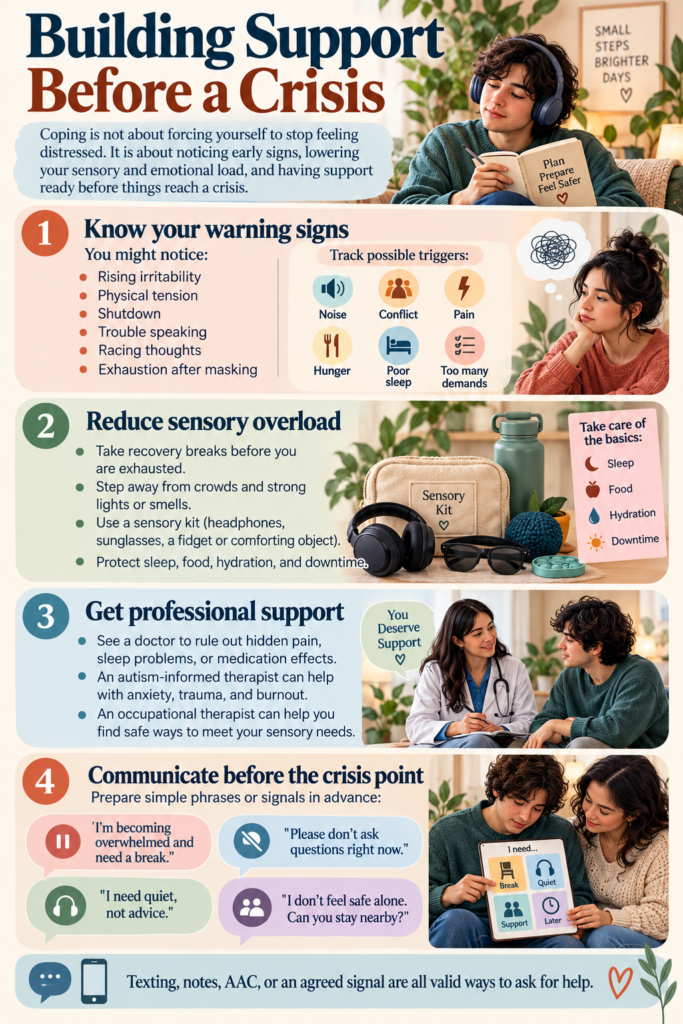
Coping is not about forcing yourself to stop feeling distressed. It is about noticing early signs, lowering your sensory and emotional load, and having support ready before things reach a crisis.
Know your warning signs. You might notice rising irritability, physical tension, shutdown, trouble speaking, racing thoughts, or exhaustion after masking. Writing down what happened before past episodes (noise, conflict, pain, hunger, poor sleep, too many demands) can help you spot patterns earlier.
Reduce sensory overload. When your body is overwhelmed, changing the environment often helps more than telling yourself to calm down. Build in recovery time before you are exhausted, step away from crowds and strong lights or smells, keep a sensory kit (headphones, sunglasses, a fidget, a comforting object), and protect sleep, food, hydration, and downtime.
Get professional support. See a doctor to rule out hidden pain, sleep problems, or medication effects. An autism-informed therapist can help with anxiety, trauma, and burnout, and an occupational therapist can help you find safe ways to meet your sensory needs. For more detail, see the [National Autistic Society’s guidance on self-harm]. For more detail, see the National Autistic Society’s guidance on self-harm. In the UK, the NICE guideline on [self-harm: assessment, management and preventing recurrence] sets out recommended care for adults who self-harm, including people with neurodevelopmental conditions.
Communicate before the crisis point. You do not have to explain everything in the moment. Prepare simple scripts or signals in advance:
- “I am becoming overwhelmed and need a break.”
- “Please do not ask questions right now.”
- “I need quiet, not advice.”
- “I am not safe alone. Can you stay nearby?”
Texting, notes, AAC, or an agreed hand signal are all valid ways to ask for help.
Make a personal crisis plan. A written plan makes decisions easier when your thinking feels flooded. Include:
- Your warning signs and triggers
- Three soothing activities you can do alone
- Two people you can contact, and what you want them to say or do
- Your preferred way to communicate (for example, texting rather than calling)
- A safe place to go
- Your local emergency number and a crisis line
Caring for Injuries
Clean minor wounds with mild soap and water and cover them. Seek medical care for deep or infected wounds, bleeding that won’t stop, burns, or any hard blow to the head. Asking for medical help is a safe and sensible step. Doctors and nurses are there to treat injuries, and you can ask for autism-informed care.
How to Support an Autistic Adult Who Self-Harms
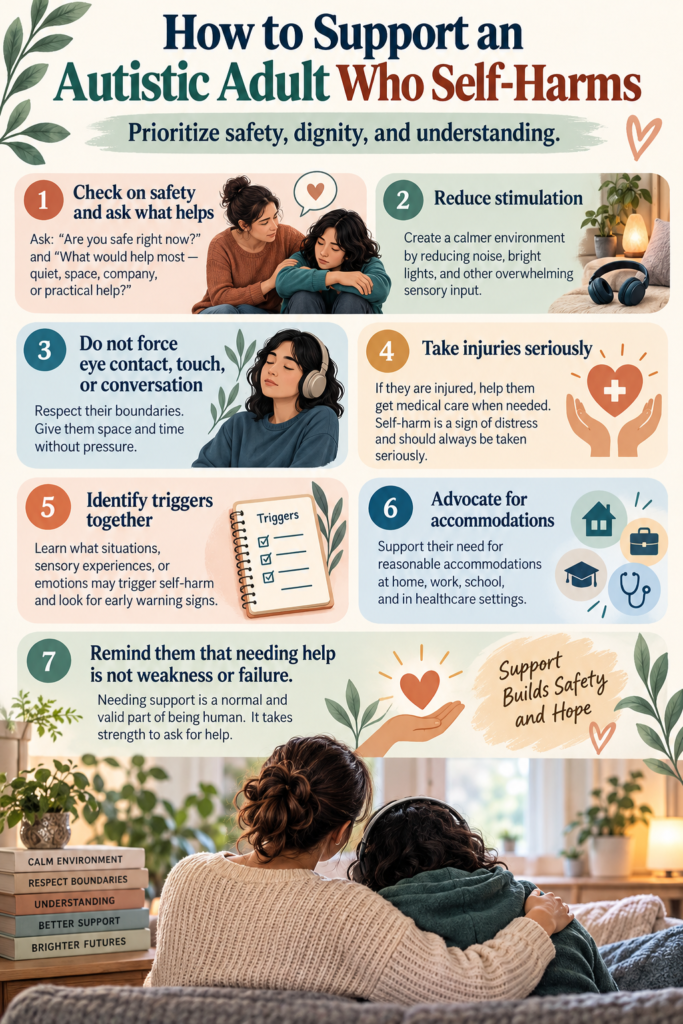
Avoid panic, blame, or demands to “just stop.” Focus on safety, dignity, and understanding.
- Ask: “Are you safe right now?” and “What would help most: quiet, space, company, or practical help?”
- Reduce stimulation rather than adding questions or instructions.
- Do not force eye contact, touch, or conversation.
- Take injuries seriously and help them get medical care when needed.
- Learn their triggers and early warning signs together.
- Advocate for accommodations at work, home, school, and in healthcare.
- Remind them that needing help is not weakness or failure.
When to Seek Urgent Help
If you cannot stay safe, have seriously injured yourself, or are thinking about ending your life, contact your local emergency number, go to the nearest emergency department, or reach a crisis line through findahelpline.com. You deserve immediate, respectful, autism-informed care.
A Final Message
If you self-harm, you are not broken, dramatic, or beyond help. Your pain is real, and it deserves care. Healing does not mean becoming less autistic. It means building a life with fewer unnecessary crises, safer ways to cope, people who understand you, and support that treats you as a whole person, not a problem to be managed.
Disclaimer: This article is for informational and educational purposes only and does not replace personalized medical, mental health, or clinical advice. If you are struggling, please speak with a licensed professional or contact a crisis service.
Leave a Reply