24 Oct 2026 · @Rubab N
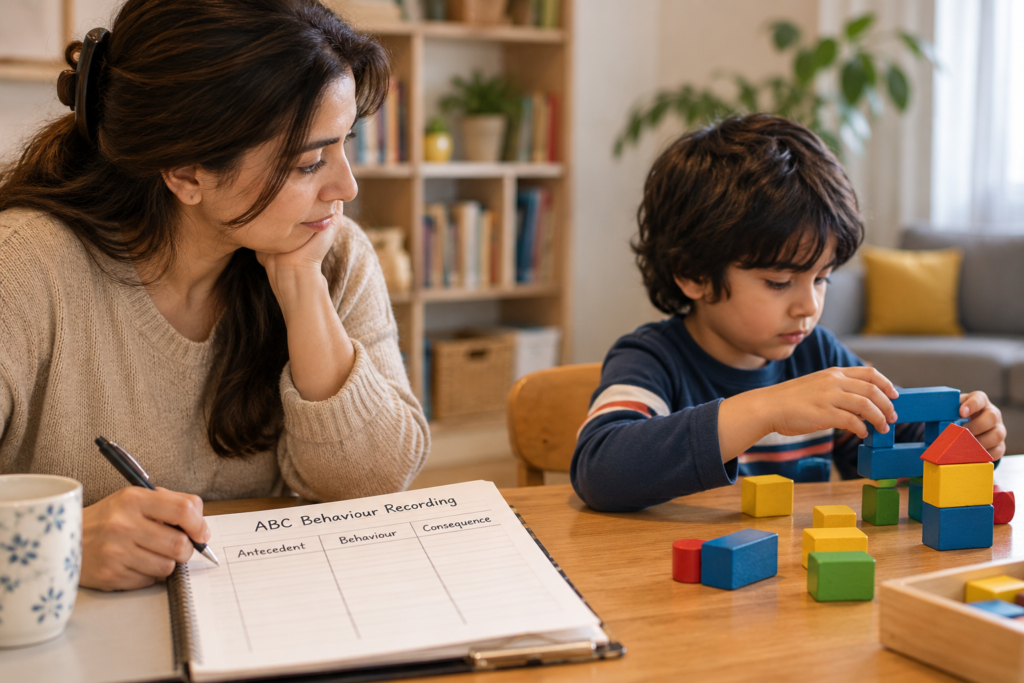
ABC Behaviour Recording is a game-changer when your child’s behaviour feels random, three simple printed sheets and a pen can show you it isn’t. Behaviour is communication, and for many autistic children, especially those with few words, a meltdown, a push or a run for the door is the clearest way to say “this is too much” or “I need something.” In the heat of the moment, with everyone upset and tired, the reason is almost impossible to see. Written down afterwards, it often becomes much easier to spot.
That is what ABC recording does, and you don’t need special training to do it. This guide explains the method in plain language and comes with a free printable PDF pack of three sheets: Sheet 1, a blank ABC chart; Sheet 2, a quick-reference page for the fridge; and Sheet 3, a weekly pattern summary. Each section below tells you which sheet to reach for and when.
This guide is general information for families. It does not replace advice from your child’s doctor, psychologist or behaviour analyst.
What is ABC recording?
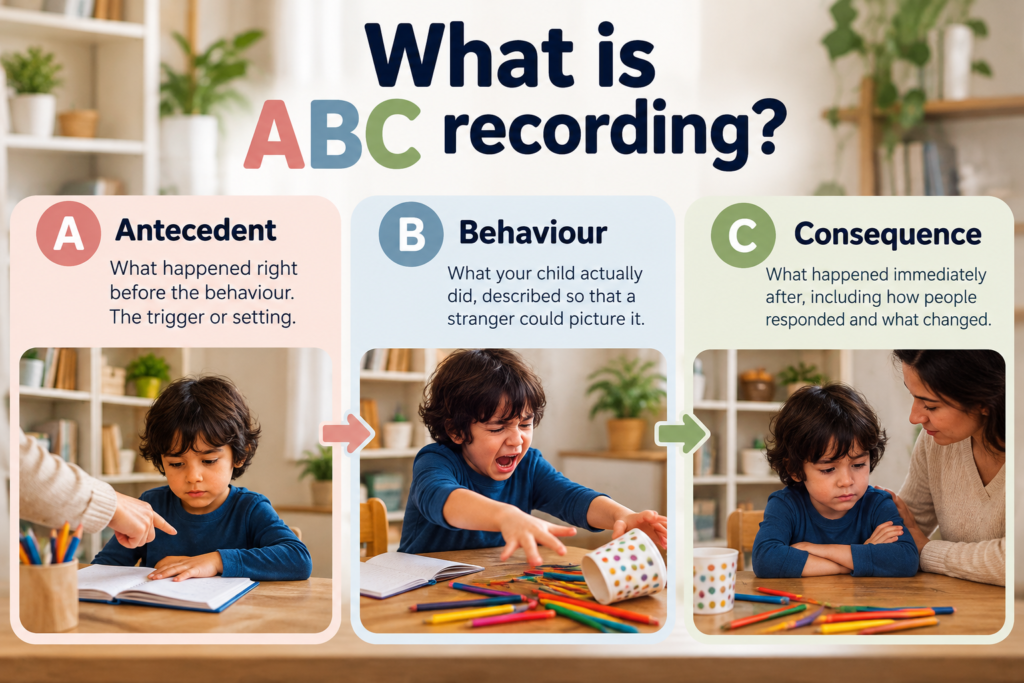
ABC recording is a three-part note about one incident: what came before, what your child did, and what happened next. The letters stand for:
- A, Antecedent: what happened right before the behaviour. The trigger or setting.
- B, Behaviour: what your child actually did, described so that a stranger could picture it.
- C, Consequence: what happened immediately after, including how people responded and what changed.
One incident tells you very little. Ten or fifteen start to show a pattern. Perhaps most outbursts follow a change of plan. Perhaps hitting happens when a task is hard and stops when the task is taken away. Behaviour analysts use patterns like these to work out what a behaviour is for, and that is the starting point for support that fits your child.
Get set up: your three printable sheets
Download the PDF pack at the end of this post and print it. Everything is colour-coded the same way on every sheet: A is blue, B is orange and C is green, so you can find the right column at a glance, even when you are tired or in a hurry.
| Sheet | What it is | When you use it |
|---|---|---|
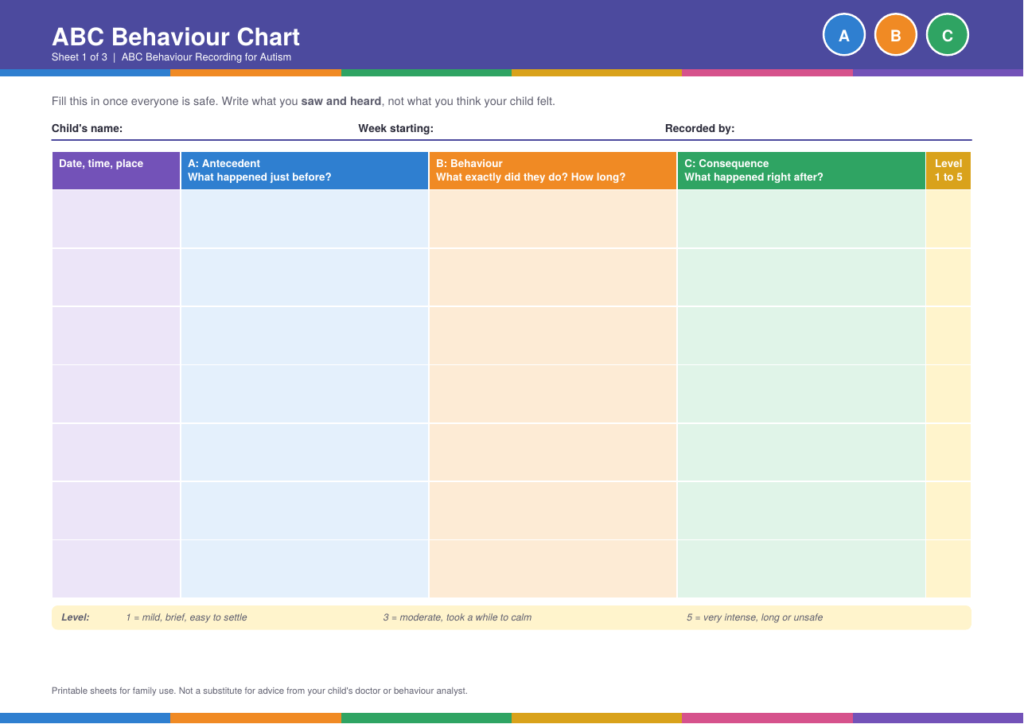
| Sheet 1: ABC Behaviour Chart | A landscape chart with seven rows to write in. | After each incident. Print several copies. |
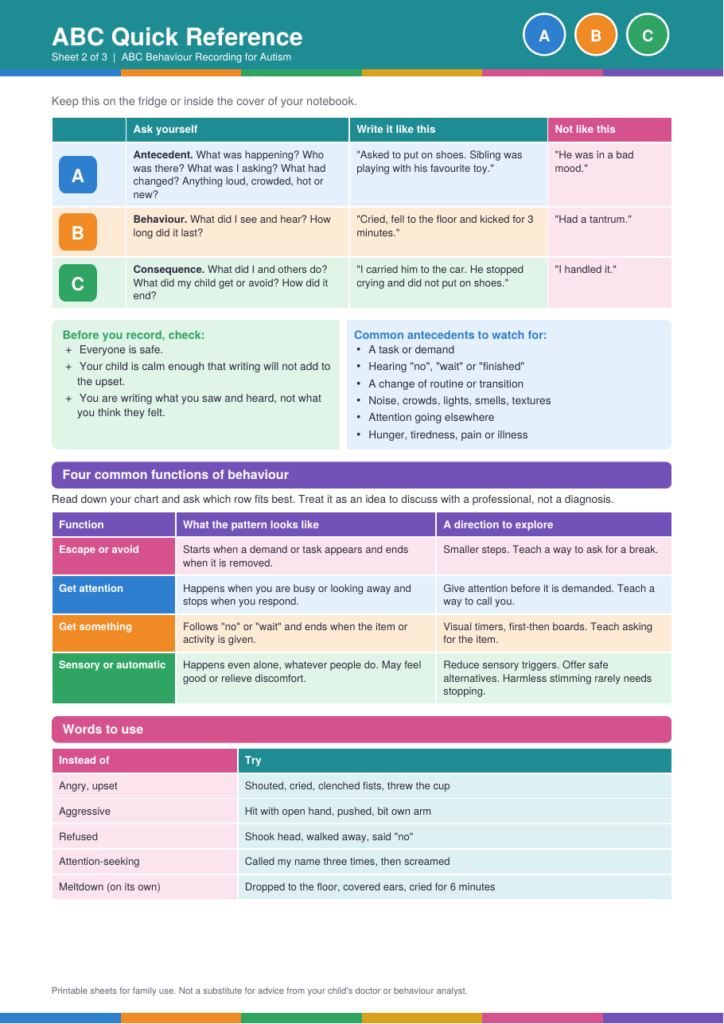
| Sheet 2: ABC Quick Reference | One page with prompts, examples, the four functions of behaviour and a “words to use” guide. | Stick it on the fridge or inside your notebook cover. |
| Sheet 3: Weekly Pattern Summary | A tally grid by trigger and day, with six questions to answer. | Once a week, with a cup of tea. |
Keep a few copies of Sheet 1 where incidents tend to happen: the kitchen, the car, the school bag. The easier the sheet is to reach, the more likely you are to use it.
How to fill in your ABC Behaviour Recording, step by step
Fill in the chart as soon as it is safe, while the details are fresh. Keep your notes short and factual.
- Make sure everyone is safe first. Recording comes after a dangerous moment, never during it.
- Fill in the date, time and place in the purple column. Time of day and location often turn out to matter.
- Blue column, Antecedent. Note who was there, what was being asked, what had just changed, and anything unusual such as noise, hunger, tiredness or a new person. Write what you saw, not what you assume.
- Orange column, Behaviour. Say exactly what your child did and for how long. Write “screamed, dropped to the floor and kicked the door for about 4 minutes”, not “had a tantrum” or “was being difficult”.
- Green column, Consequence. Write what you and others did straight afterwards, and what your child got or avoided. Did the demand stop? Did they get a snack, a screen or attention? Were they moved to another room?
- Yellow column, Level. Give the incident a number from 1 to 5, using the key at the bottom of the sheet. This shows you whether things are getting better or worse over time.
- Repeat for at least one to two weeks. Patterns need several examples before you can trust them.
Use facts, not feelings. “He was angry” is a guess. “He clenched his fists, shouted and threw the cup” is something anyone could verify, and it is far more useful to a teacher or therapist reading it later.
A worked example
These three entries are invented to show the level of detail that helps. Notice that none of them says why the child “did it”. They only say what happened.
| Date, time, place | A: Antecedent | B: Behaviour | C: Consequence | Level |
|---|---|---|---|---|
| Mon 4:30 pm, kitchen | Mum said “Time to turn off the tablet for dinner.” Child was mid-game. | Screamed, threw the tablet on the floor, cried for about 5 minutes. | Mum gave the tablet back and said “Five more minutes.” Crying stopped at once. | 4 |
| Wed 10:15 am, classroom | Teacher gave a worksheet with 10 maths questions. Room was noisy. | Pushed the worksheet off the desk, put head down, then hit the table. | Teacher removed the worksheet. Child was allowed to sit in the quiet corner. | 3 |
| Fri 5:45 pm, supermarket | Busy shop, bright lights. Child had not eaten since lunch. Dad said no to a snack. | Dropped to the floor, covered ears, screamed for 3 minutes. | Dad picked child up and left the shop. Child calmed in the car. | 5 |
In the first entry, stopping the tablet led to a meltdown, and the meltdown led to more tablet time. In the second, the worksheet and the noise came first, and the behaviour ended the task. The third points to sensory overload and hunger. Same child, three different possible reasons, which is exactly why recording helps.
Reading your patterns with Sheet 2
Most behaviours serve one of four purposes, and some serve more than one. After a week or two, read down your chart and ask which row below fits best. Sheet 2 carries this same table, so you can check it any time. Treat the answer as an idea to discuss with a professional, not a diagnosis.
| Function | What the pattern looks like | Example | A direction to explore |
|---|---|---|---|
| Escape or avoid | Behaviour starts when a demand, task or place appears and ends when it is removed. | Hits the worksheet, then the worksheet is taken away. | Break tasks into smaller steps. Teach a way to ask for a break. |
| Get attention | Behaviour happens when you are busy or looking away and stops when you respond. | Shouts while Mum is on the phone, Mum turns to look. | Give attention before it is demanded. Teach a way to call you. |
| Get something | Behaviour follows hearing “no” or “wait” and ends when the item or activity is given. | Screams for the tablet, gets the tablet. | Use visual timers and first-then boards. Teach asking for the item. |
| Sensory or automatic | Behaviour happens even when alone and regardless of what people do. It may feel good or relieve discomfort. | Hand-flapping, rocking, covering ears in a loud room. | Reduce sensory triggers. Offer safe alternatives. Do not stop harmless stimming. |
One caution on the last row: stimming such as flapping or rocking is a normal way for many autistic people to regulate, and it often does not need to be stopped. Record it only if it is harmful or if a professional has asked you to.
Your weekly review with Sheet 3
Once a week, sit down with your filled-in charts and Sheet 3. Make one mark for each incident in the row that matches its trigger and in the column for the day it happened. At the end of the week, the row with the most marks is your biggest trigger.
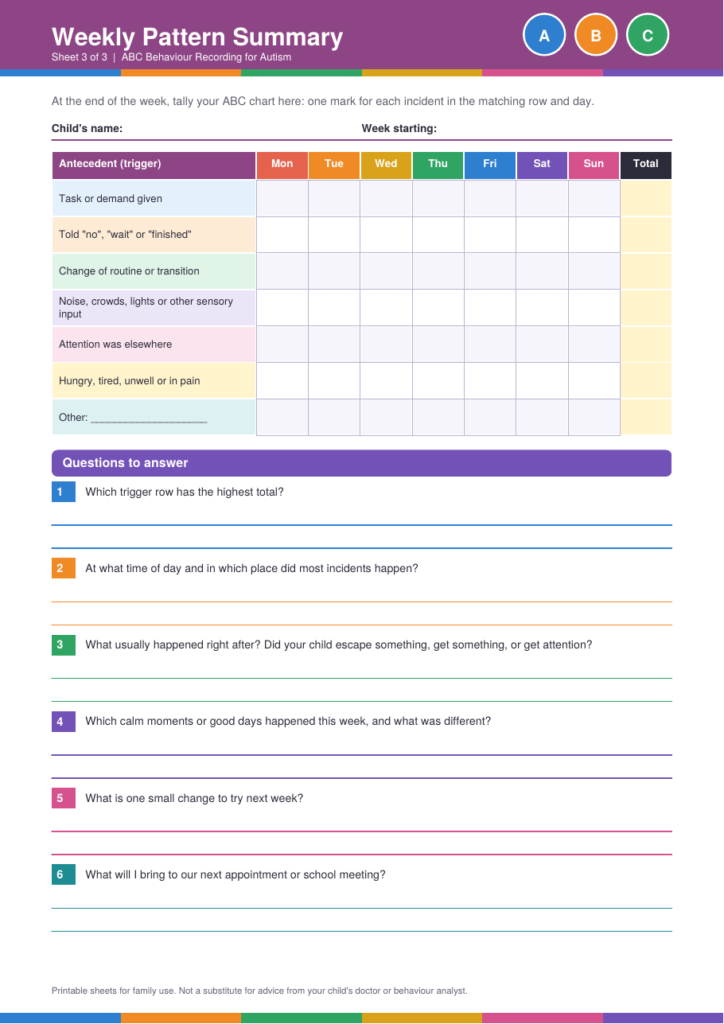
Then answer the six questions at the bottom of the sheet. Two of them matter most: what happened right after the behaviour, and which calm moments or good days happened this week. The first points to what the behaviour achieves for your child. The second shows you what is already working, so you can do more of it.
Bring Sheet 3 to appointments and school meetings alongside your charts. A page like this tells a professional far more than “it has been a hard few weeks.”
Tips, common mistakes and looking after yourself
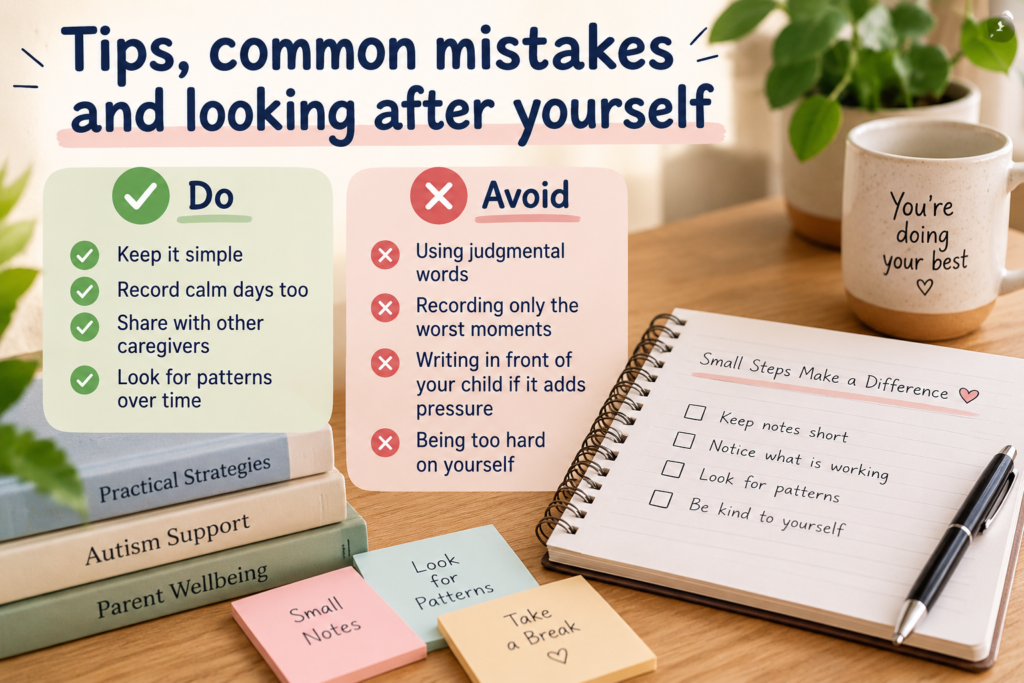
Keep the habit small enough that you will actually do it. A short, imperfect note beats a perfect one you never write.
Do
- Keep printed copies of Sheet 1 in the kitchen, the car and the school bag.
- Record the calm days too, or note when a usual trigger did not cause a problem.
- Share the chart with other caregivers, so everyone writes in the same way.
- Look for patterns once a week with Sheet 3, not after every incident.
Avoid
- Guessing at reasons or using words like “naughty”, “attention-seeking” or “manipulative”. The “words to use” table on Sheet 2 offers better wording.
- Recording only the worst moments, which hides what is working.
- Writing in front of your child during an upset, if it adds pressure.
- Judging yourself. The green column describes what happened, and every parent responds in ways they later wish they hadn’t.
Recording can feel heavy when you are already exhausted. If it starts to feel like surveillance of your own child, take a break and return to it later with someone supporting you.
When to share your records and get support
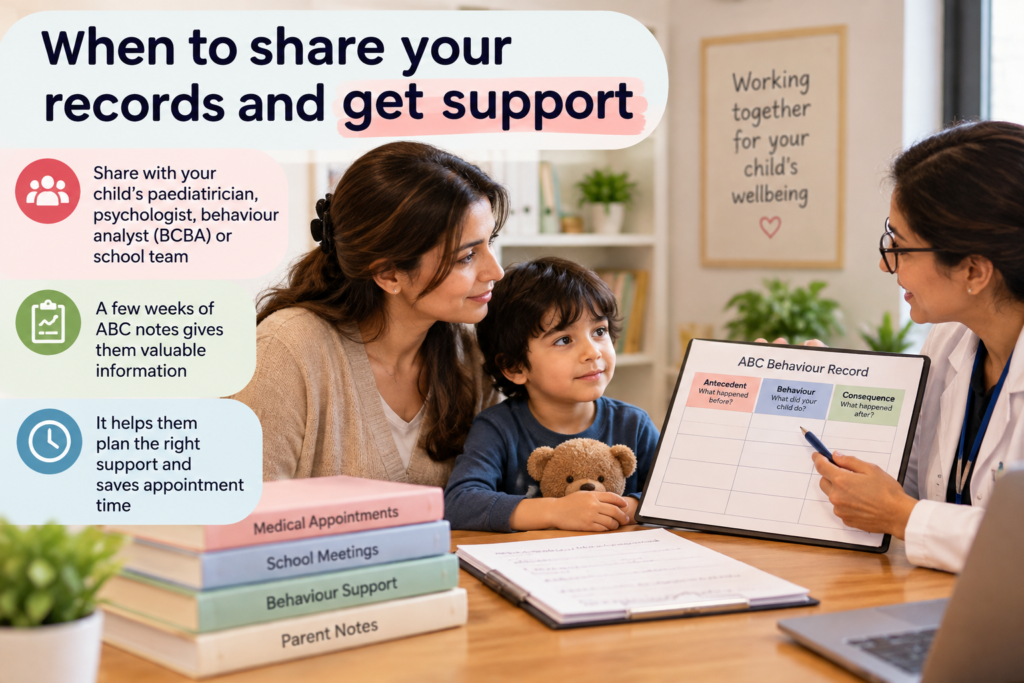
Bring your charts and your weekly summary to your child’s paediatrician, psychologist, behaviour analyst (BCBA) or school team. A few weeks of ABC notes gives them far more to work with than a general description, and it saves appointment time.
Seek help promptly if any of these apply:
- Your child, or anyone else, is being hurt or is at risk of harm.
- A behaviour is getting worse, more frequent or more intense over several weeks.
- A sudden change in behaviour appears with no clear cause. It can signal pain, illness, poor sleep or a change at school, so rule out medical causes first.
- You feel unable to cope. Support for caregivers is part of good care.
If there is immediate danger, contact your local emergency services.
Download your printable pack
ABC_Behaviour_Printable_Sheets.pdf is a free, three-page A4 pack: Sheet 1 (landscape), Sheet 2 and Sheet 3 (portrait). Download it, print as many copies as you like, and start with the next incident.
A few printing tips:
- Print in colour if you can. The blue, orange and green columns make the chart quicker to use. A black-and-white print still works, because every column is labelled.
- Choose “Actual size” rather than “Fit to page” so the writing spaces stay large. On US Letter paper, “Fit to page” is fine.
- Print Sheet 1 several times and keep the copies in a folder. Laminate Sheet 2 if it will live on the fridge.
- Sheet 1 is in landscape. Most printers pick this up automatically, but if the page is cut off, set the orientation to landscape.
You do not need to record everything forever. Two weeks of honest notes is often enough to see what is going on, and to start a much better conversation about how to help.
Disclaimer: The practical routines and visual tools shared on The Autism Routine Hub are for informational and educational purposes only. Every individual on the spectrum is unique, and these strategies do not replace personalized medical, behavioral, or clinical advice. Please consult with a licensed professional regarding your family’s specific needs.
Leave a Reply