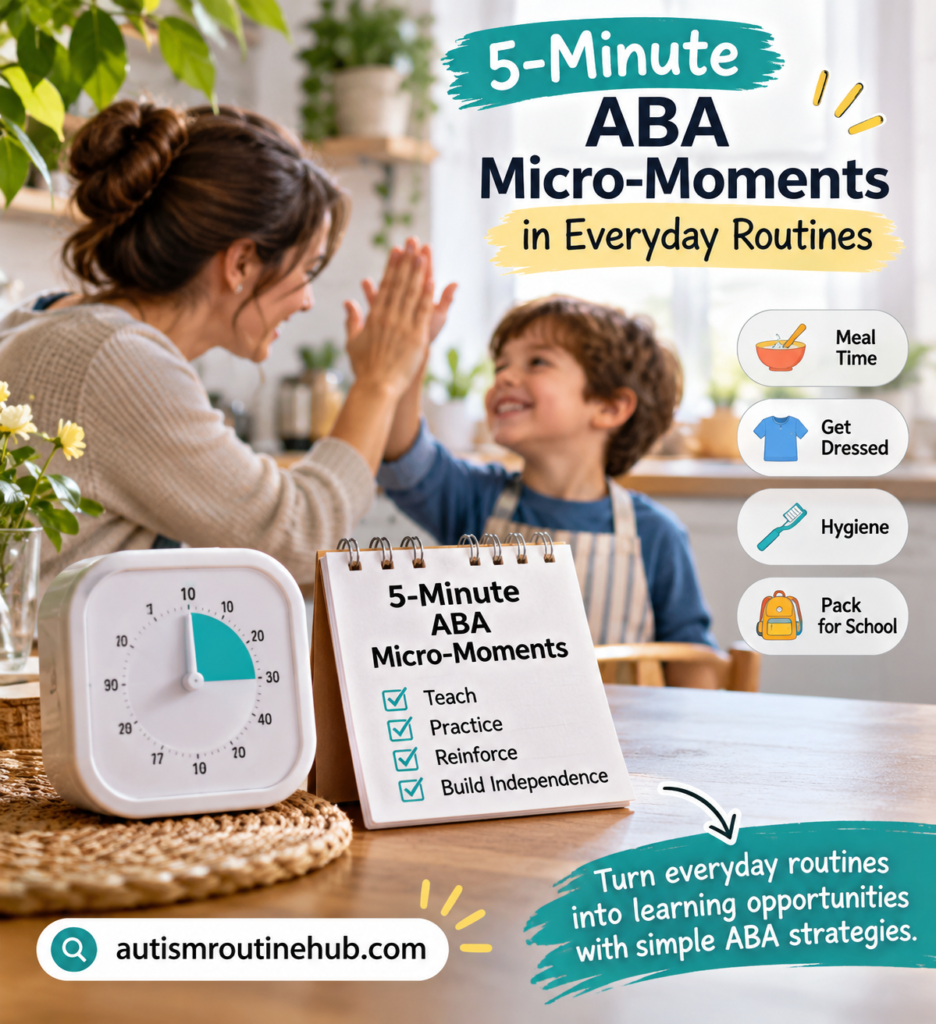
You don’t need a therapy room, a clipboard, or an hour to practice ABA [2]
in everyday routines—you just need five minutes and a daily habit you already have.
Most parents and caregivers picture “ABA” as something that happens at a table, with data sheets and a professional. But a child’s biggest learning laboratory is the ordinary day: the shoe-hunt at 7:40 a.m., the snack that arrives in the wrong cup, the bath that nobody wants to end.
This post shows how to turn those moments into tiny, repeatable practice sessions using simple Applied Behavior Analysis (ABA) ideas. No special materials. No extra time on the calendar. Just five minutes, used on purpose.
What is a micro-moment in ABA in everyday routines?
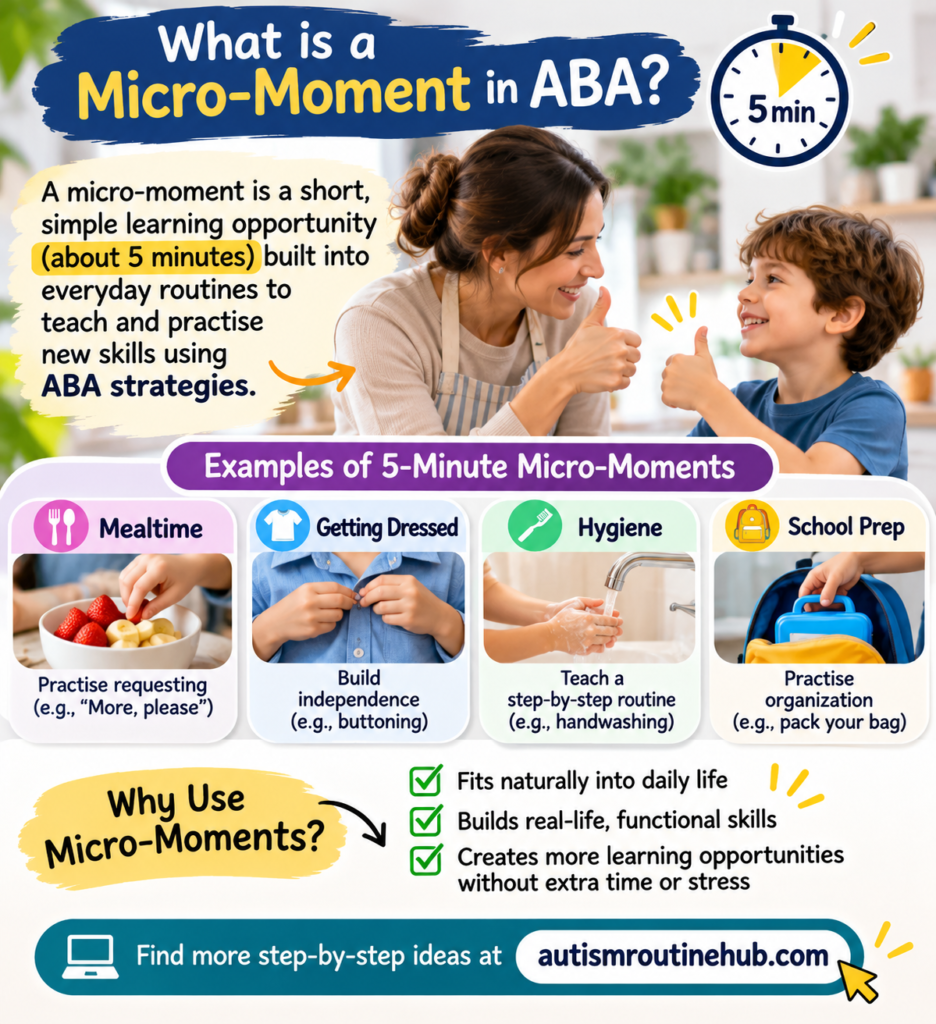
A micro-moment is one short, planned teaching chance inside a routine you already do. It lasts about five minutes, targets one small skill, and ends on a win.
Every micro-moment runs on the ABCs of behavior:
- A – Antecedent: what happens right before (“Time to put on shoes.”)
- B – Behavior: what the child does (puts on one shoe)
- C – Consequence: what happens right after (“Yes! You did that yourself!” plus a high-five)
When a behavior is followed by something the child likes, they do it more often. That is reinforcement, and it is the engine behind everything below [1]
The 5-minute rule: pick ONE routine, ONE skill, and ONE way to reward it. Stop while it is still going well.
Morning: the “I can do it” five minutes
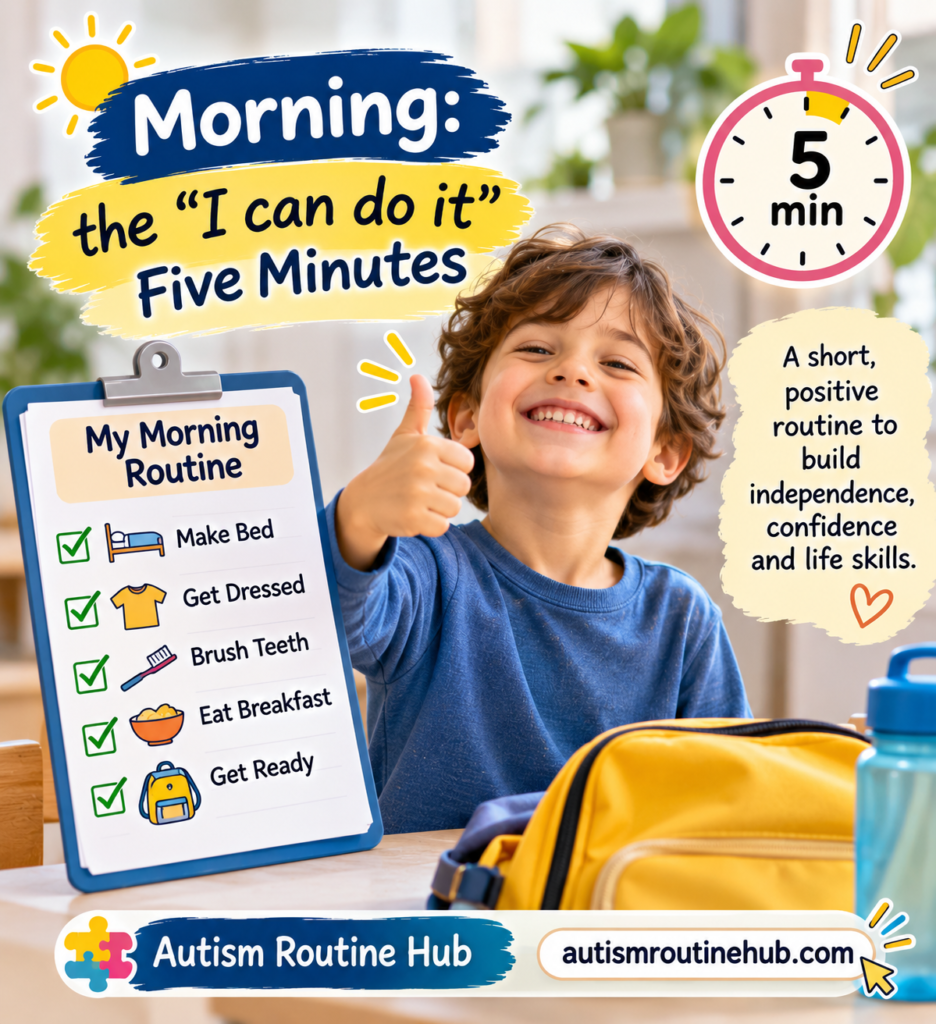
Mornings are rushed, which makes them perfect for small independence skills. Choose one step, not the whole routine.
Micro-moment 1: Back-chain the shoes. You do most of the job, and the child does only the last step (pulling the heel up). Celebrate it. Next week, they do the last two steps. Finishing is the most rewarding part, so start there.
Micro-moment 2: Two-choice dressing. Hold up two shirts and ask, “Red or blue?” Choice-making builds cooperation and communication, and it removes the power struggle of “put this on.”
Micro-moment 3: First-Then. Say: “First brush teeth, then music on.” Short, clear, and the reward is already built in.
Try it tomorrow: pick just one of these three. Say your words once, wait five seconds, and give a specific cheer: “You pulled your heel up all by yourself!”
Mealtime: the “ask for it” five minutes
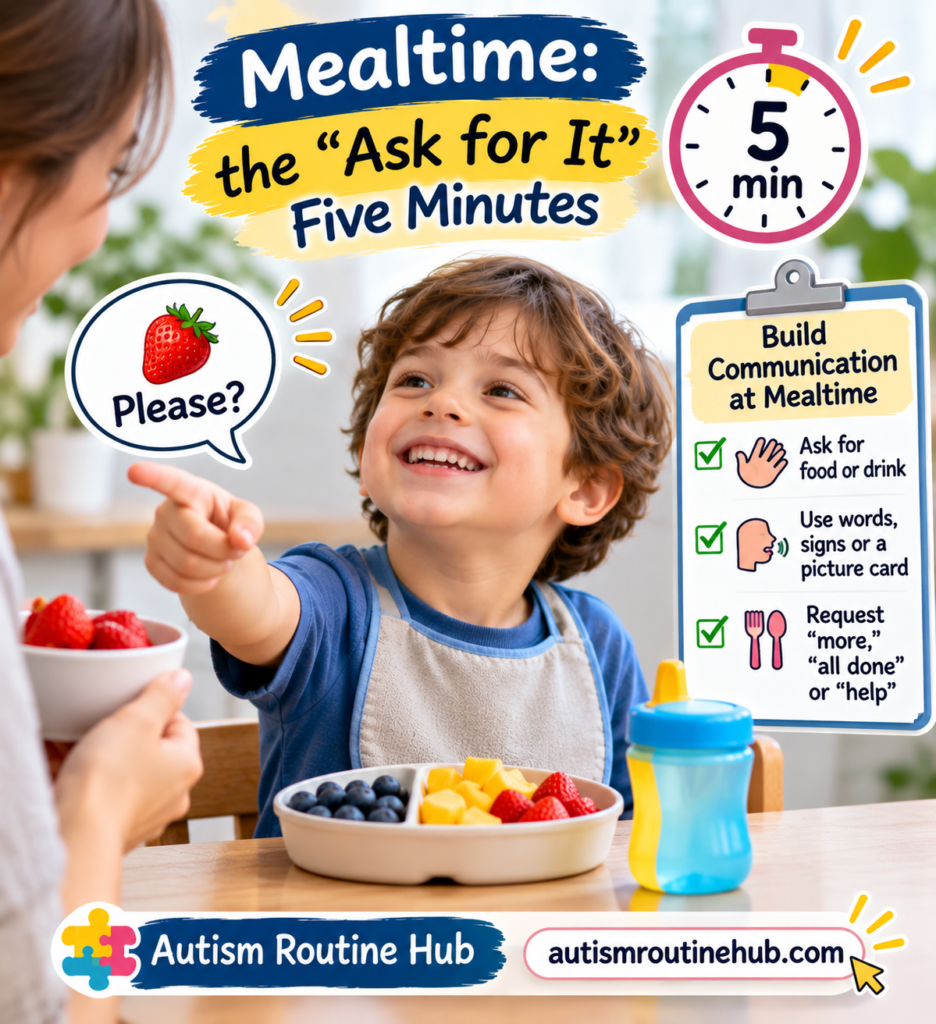
Children are motivated at meals, and motivation is what makes communication practice stick. Use it.
Micro-moment 4: Create a tiny need. Place the juice slightly out of reach, or serve the cereal without the spoon. Pause and wait. Whatever they do to ask (a word, a sign, a point, a picture) gets the item right away. This is called manding, or requesting, and it is one of the most useful skills you can build.
Micro-moment 5: Expand one step. If your child says “juice,” model one step up: “More juice!” Give the juice immediately, with no quiz and no “say it again.”
Micro-moment 6: The “one bite” bridge. For picky eating, put one tiny piece of a new food on the plate beside a favorite. Praise any contact, whether touching, smelling, or licking. Small approximations count, and pressure is not part of the plan.
Try it tomorrow: give the snack in two or three small portions instead of all at once. Each portion is a fresh chance to ask.
Transitions: the “calm change” five minutes
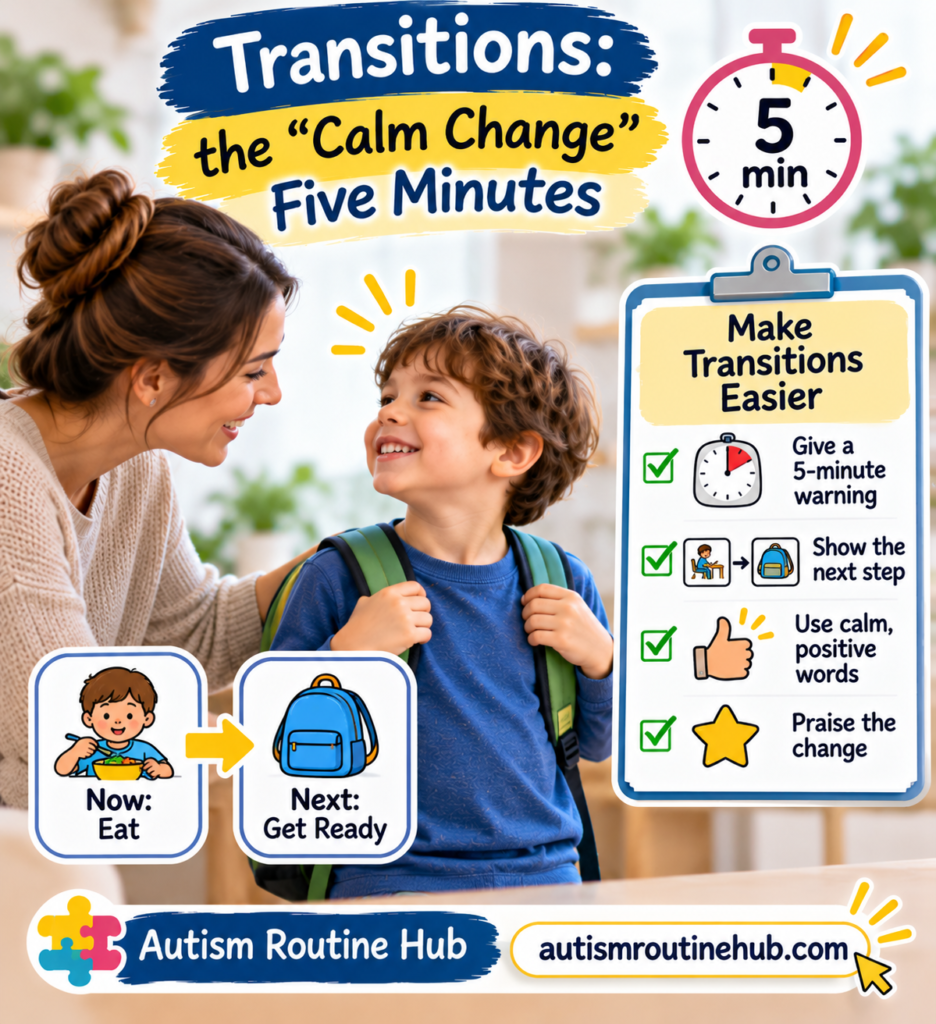
Stopping a fun activity is hard for many kids. These tools make the change predictable.
Micro-moment 7: The countdown. Give a warning at 5 minutes, 2 minutes, and “last one.” A visual timer works even better because the child can see time shrinking.
Micro-moment 8: Transition object. Let them carry a favorite toy from the playroom to the car. The object bridges the gap between “here” and “there.”
Micro-moment 9: Reinforce the easy transition. When your child stops on the first warning, even slightly, celebrate it right away: “You turned off the tablet so fast! Now we can go to the park.” Catch the good transitions, not just the hard ones.
Try it tomorrow: pick ONE transition (for example, screen time to dinner) and use the same three-step warning every day this week. Consistency is what makes it work.
Play, bath and bedtime: the “connect and wind down” five minutes
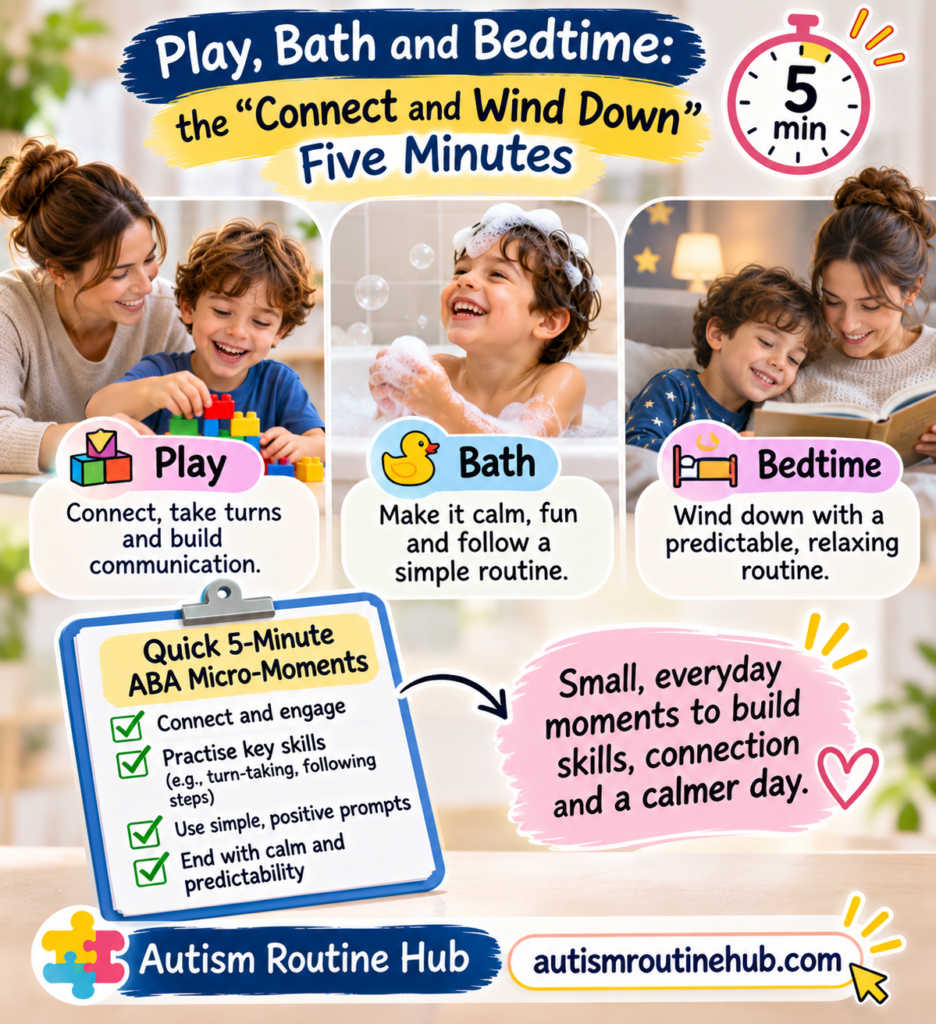
Micro-moment 10: Follow their lead, add one step. Join whatever they are doing, then add one tiny twist. They line up cars; you add a ramp. They stack blocks; you hand over the next one and wait. Taking turns, imitation, and joint attention all grow here.
Micro-moment 11: Bath-time labeling. Water play is full of vocabulary: pour, splash, bubbles, wet, empty, full. Say one word, pause, and let them fill in the gap: “Ready, set… ?”
Micro-moment 12: The bedtime picture chain. Use 3 to 4 simple pictures (pajamas, teeth, book, lights off). Point to each step and let your child move a finished card into a “done” pocket. Predictability lowers bedtime battles.
Micro-moment 13: Praise the quiet. When your child lies calmly, whisper your praise: “I love how your body is resting.” Quiet behavior is easy to miss, so notice it on purpose.
Your pocket toolkit
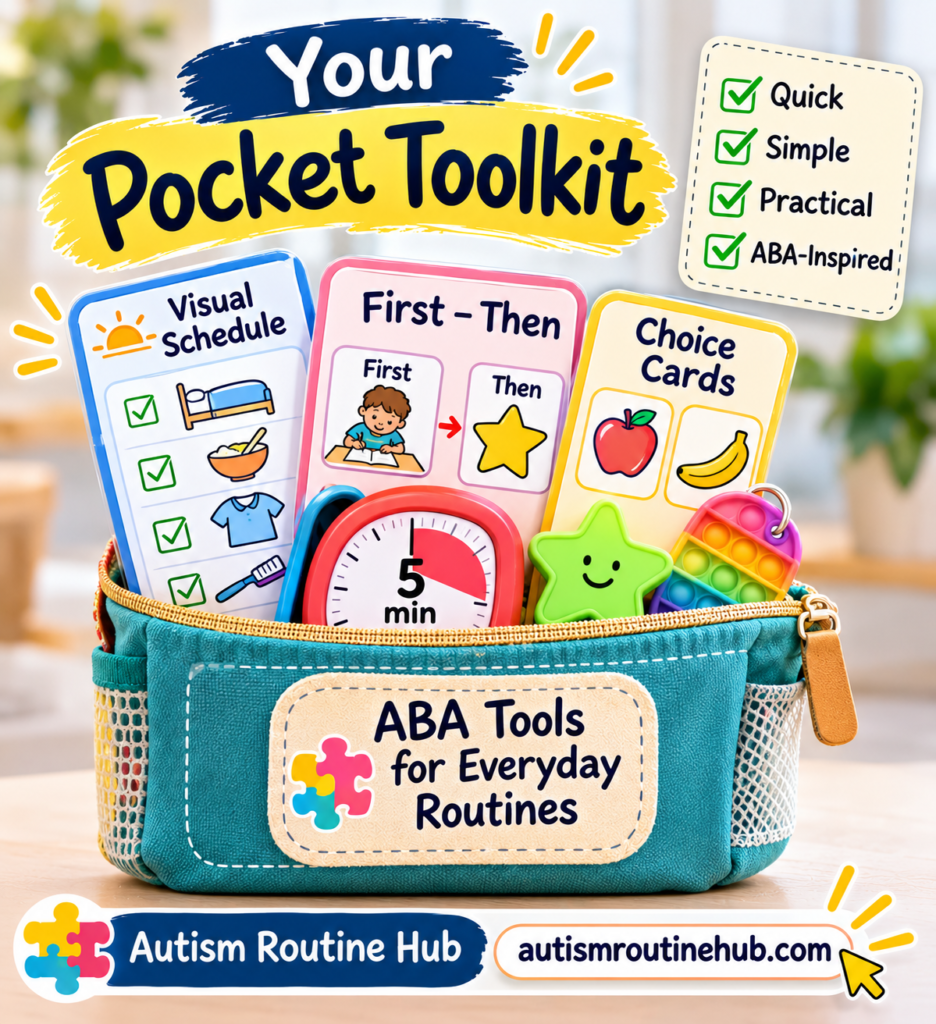
Four habits make every micro-moment work better.
| Tool | What it means | Example |
|---|---|---|
| Specific praise | Name exactly what went well | “You waited so patiently!” |
| Immediate reward | Deliver the good thing within a few seconds | Cheer right as the shoe goes on |
| Prompt, then fade | Give the smallest help needed, then do less each time | Point to the shoe, then just look at it, then nothing |
| Quick tally | Note a win in 10 seconds | A tick on a sticky note or phone |
Three mistakes to skip:
- Doing too much at once. One skill per micro-moment.
- Waiting for perfect. Reward progress, not just finished results.
- Ending on a struggle. If it is going badly, make it easier, get one success, and stop.
Start small this week
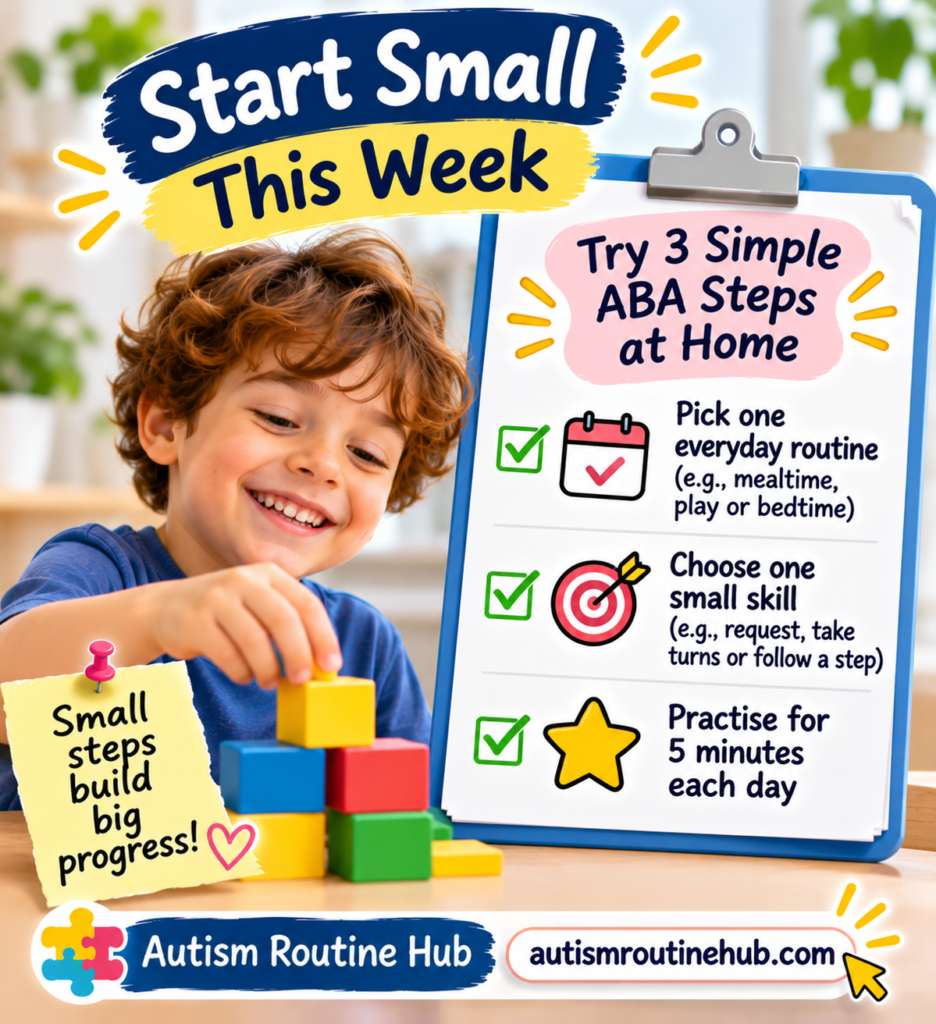
Pick one routine and one micro-moment from this post. Run it for five minutes a day for seven days, and jot a tick each time your child succeeds. By day seven, you will likely see progress, and you will have proof that learning happens in ordinary moments.
If your child has a behavior plan or works with a Board Certified Behavior Analyst (BCBA), share these ideas with them first so everything fits your child’s goals. For serious challenges such as aggression or self-injury, always get professional guidance rather than trying to solve it alone.
Five minutes is small. Repeated daily, it is a lot.
Download Your Free Printable ABA at Home Cheat Sheet
Start your journey with practical, easy-to-follow steps to support your child’s learning at home.
[DOWNLOAD YOUR FREE CHEAT SHEET]
References
- Cooper, J. O., Heron, T. E., & Heward, W. L. (2020). Applied Behavior Analysis (3rd ed.). Pearson. https://www.pearson.com/en-us/subject-catalog/p/applied-behavior-analysis/P200000000905/9780137477210
- Baer, D. M., Wolf, M. M., & Risley, T. R. (1968). Some current dimensions of applied behavior analysis. Journal of Applied Behavior Analysis, 1(1), 91-97. https://pmc.ncbi.nlm.nih.gov/articles/PMC1310980
- Centers for Disease Control and Prevention. (2024, May 16). Treatment and Intervention for Autism Spectrum Disorder. U.S. Department of Health and Human Services. https://www.cdc.gov/autism/treatment/index.html
Leave a Reply