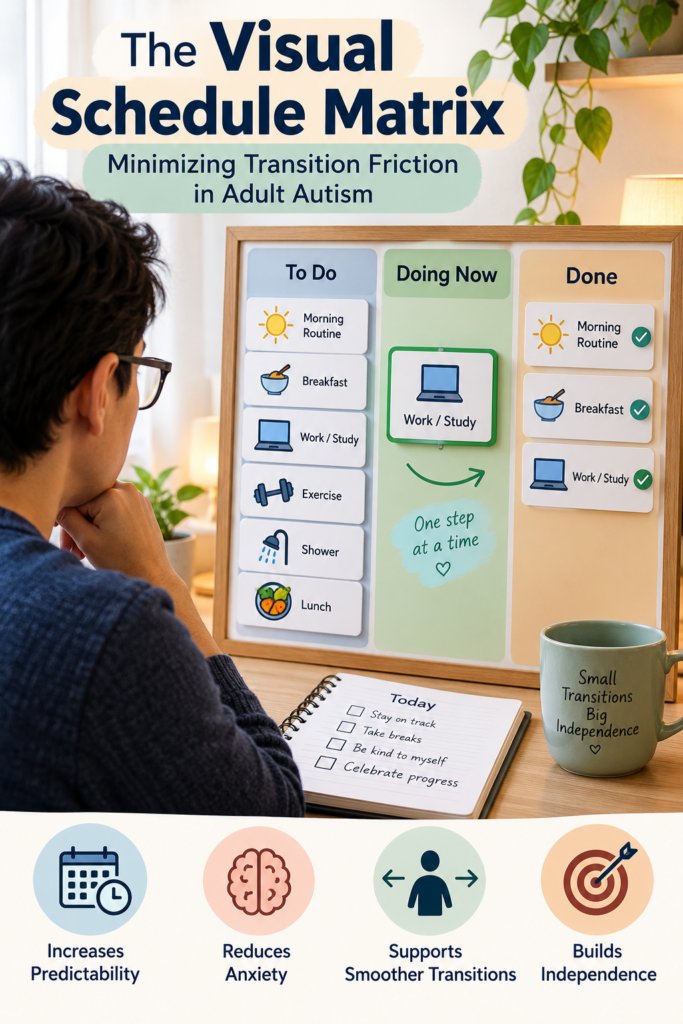
Minimizing transition friction is one of the hardest parts of the day for many autistic adults. Moving from one activity to the next is one of the hardest parts of the day for many autistic adults. Stopping a focused task and shifting to a break, a meal, or downtime means letting go, reorienting, and starting again, and when that shift is sudden or unclear it can bring on anxiety, shutdowns, or meltdowns. Verbal reminders like “we’re stopping in five minutes” often don’t help, because they disappear the moment they’re spoken and the person has to remember and track them. A visual schedule solves this by putting the day somewhere the person can see it. This guide walks through a simple three-part setup you can build at home or in a supported setting, designed with the adult, not for them.
The Science of Visual Predictability
Visual schedules are widely recommended in autism support, including by the National Autistic Society, and they are a core part of the TEACCH approach developed at the University of North Carolina. They help for a simple reason: when a person can see what is happening, in what order, and when something is finished, there is less to hold in mind and less uncertainty to manage. Research on visual schedules points the same way, though results vary from person to person, so treat any schedule as something to try and adjust.
3 Steps to Engineer a Functional Transition Matrix
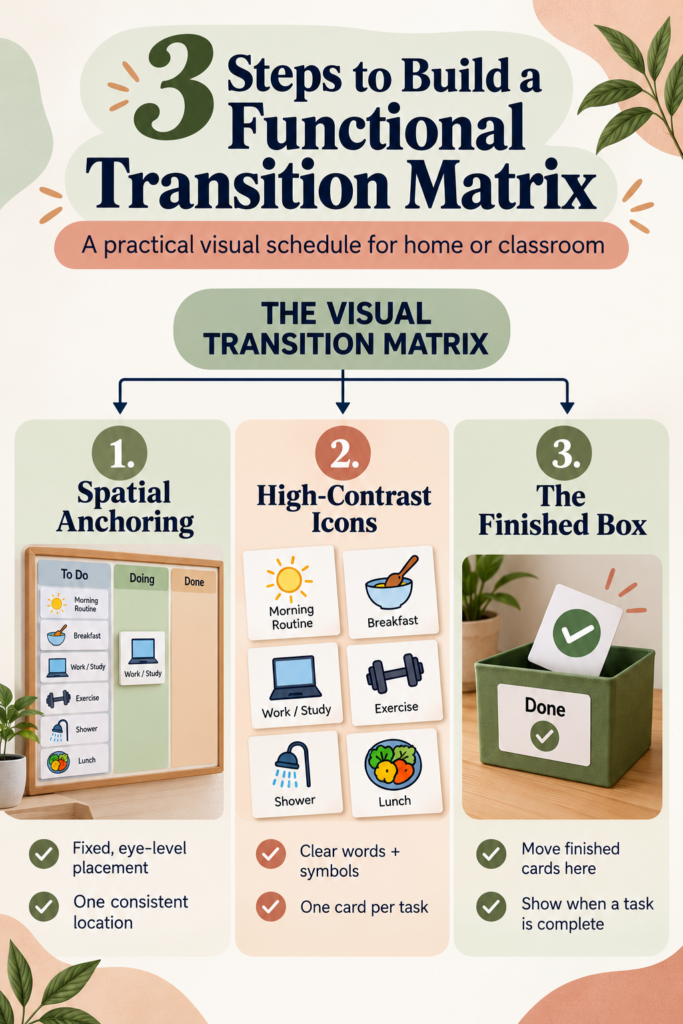
To build an institutional-grade visual schedule system for home or classroom settings, follow this precise three-part layout:
                [The Visual Transition Matrix]
                              │
       ┌──────────────────────┼──────────────────────┐
       ▼                      ▼                      ▼
[1. Spatial Anchoring] [2. High-Contrast Icons] [3. The Finished Box]
• Fixed eye-level mount • Clear text + symbols  • Physical removal
• Centralized zone     • Individual task cards • Absolute closure
1. Centralized Spatial Anchoring
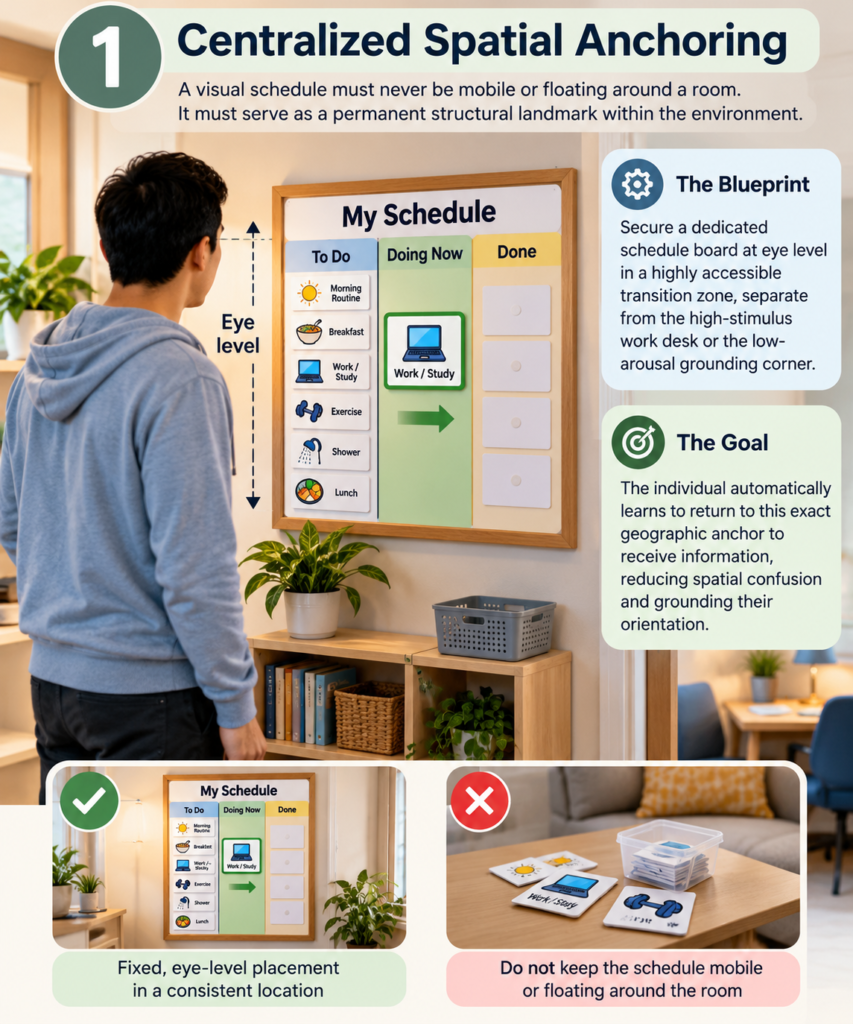
A visual schedule must never be mobile or floating around a room. It must serve as a permanent structural landmark within the environment.
- The Blueprint: Secure a dedicated schedule board at eye level in a highly accessible transition zone, separate from the high-stimulus work desk or the low-arousal grounding corner.
- The Goal: The individual automatically learns to return to this exact geographic anchor to receive information, reducing spatial confusion and grounding their orientation.
2. High-Contrast Task Cards & Individual Pacing
Generic, cluttered charts cause visual fatigue. Each activity must exist as a separate, highly legible, physical or digital card.
- The Blueprint: Use high-contrast vector icons paired with clear, minimalist text labels (e.g., WORK, BREAK, CALM TIME, LUNCH). Arrange these vertically from top to bottom to mirror a natural sequential flow.
- The Goal: A vertical sequence provides a clear chronological timeline that the brain can scan and interpret in milliseconds, removing the anxiety of the unknown.
3. The Objectified “Finished” Mechanism
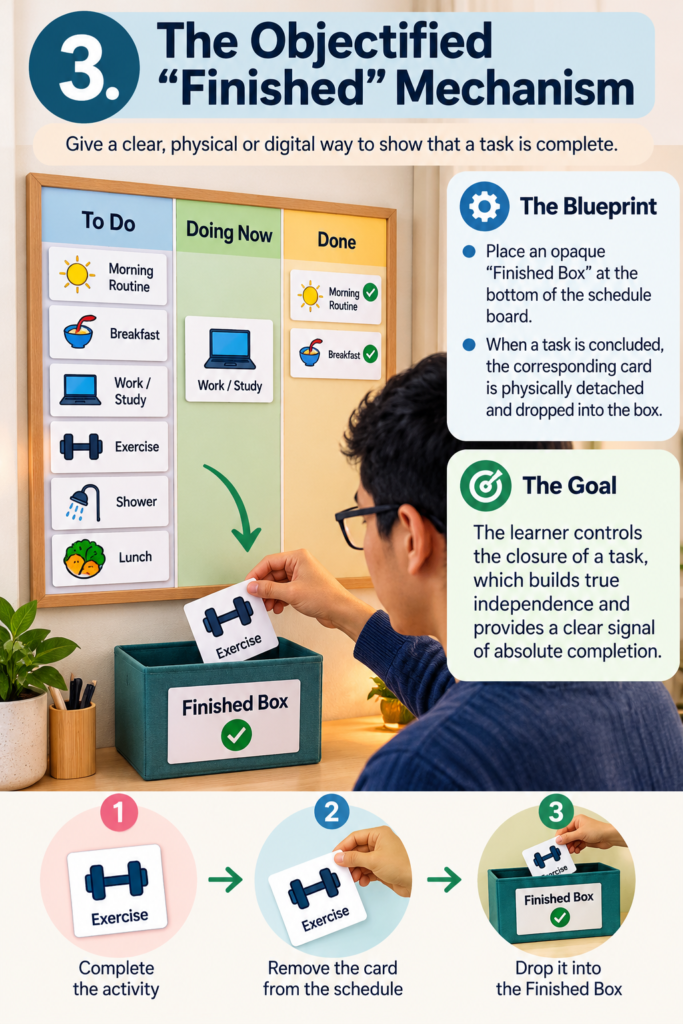
True independence is built when the learner controls the closure of a task. The schedule must include a physical or digital mechanism to signal absolute completion.
- The Blueprint: Place an opaque “Finished Box” or a dedicated envelope directly at the bottom of the schedule board. When a task is concluded, the corresponding card is physically detached and dropped into the box.
- The Goal: This physical removal creates a powerful psychological boundary. It provides cognitive closure, explicitly signaling that the task demands have ended, and smoothly sets up the transition to the next panel.
Fostering Autonomy Across the Lifespan
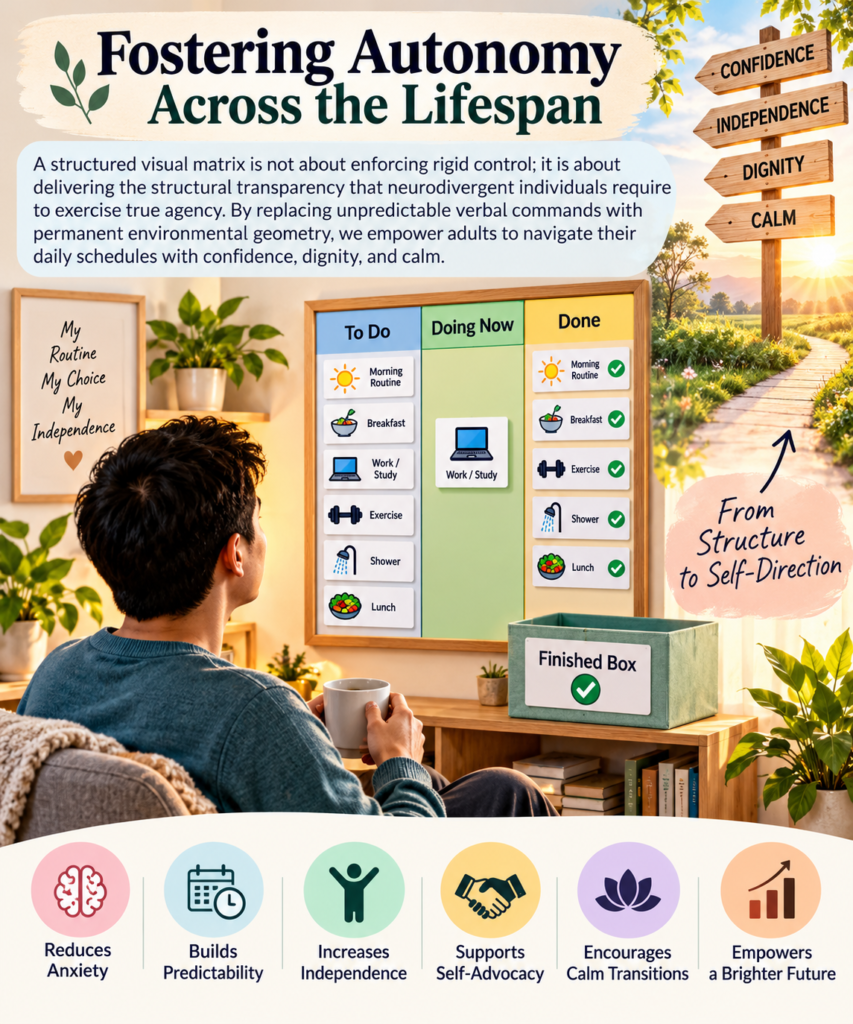
Implementing a structured visual matrix is not about enforcing rigid control; it is about delivering the structural transparency that neurodivergent individuals require to exercise true agency. By replacing unpredictable verbal commands with permanent environmental geometry, we empower adults to navigate their daily schedules with confidence, dignity, and calm.
Disclaimer: The practical routines and visual tools shared on The Autism Routine Hub are for informational and educational purposes only. Every individual on the spectrum is unique, and these strategies do not replace personalized medical, behavioral, or clinical advice. Please consult with a licensed professional regarding your family’s specific needs.
Leave a Reply